


Pixabay
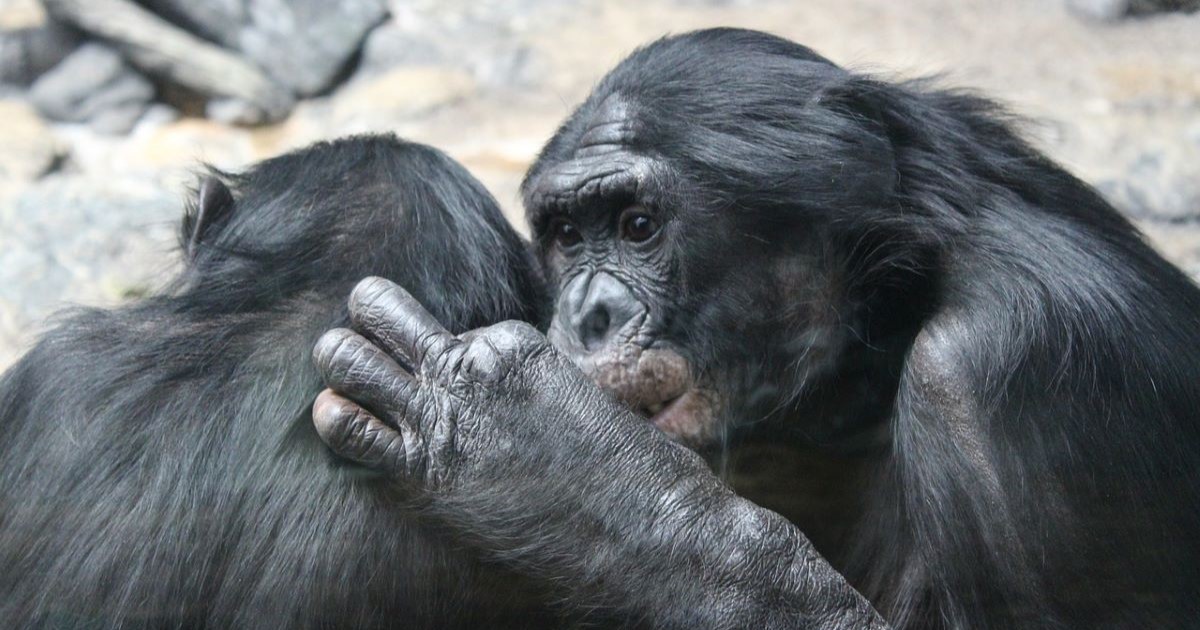
Meet the bonobo: an endangered great ape, a little smaller than the chimpanzee but very similar in that both monkeys share 98.7% of their DNA with humans, according to the WWF website.
Unlike chimpanzees however, the bonobos live in relatively peaceful, female-led communities in their habitat of the Congo Basin.
It is their social structures, behaviors and hierarchies – as well as the fact that they are humans’ closest relatives in the animal kingdom – that makes the bonobo the fascination of many animal researchers, despite the fact that they were not designated as a separate species from chimpanzees until 1929.
Since then, research and data collection on bonobos has been hampered by civil unrest in the Congo, as well as the remoteness of their habitats. However, a new study from researchers at the Max Planck Institute of Animal Behavior has provided vital new knowledge to underpin our understanding of these incredible apes.


WWF
One of the things that has puzzled researchers most over the years is how and why female bonobos consistently hold power in their societies, despite being smaller and less physically strong than their male counterparts.
This has been a contentious topic over the decades, with plenty of suggestions, but very little ability to prove them right or wrong since it has been so difficult to observe the creatures in the wild.
However, the research – which has been recently published in the journal Communications Biology – has for the first time based its findings on the observations of wild bonobos, with their data acquired over the course of thirty years, across six wild bonobo communities in the Democratic Republic of Congo.
And the results are fascinating.
Not only do female bonobos indeed hold the majority of the power in bonobo communities, they do so not in competition but in solidarity with other females.


Melodie Kreyer/LKBP
In fact, the researchers explain that female bonobos create ‘coalitions’, meaning alliances with other females to overpower male bonobos in the heirarchy. They band together against male bonobos, asserting their collective power, as Harvard University’s Martin Surbeck (the study’s first author) explained in a statement:
“To our knowledge, this is the first evidence that female solidarity can invert the male-biased power structure that is typical of many mammal societies. It’s exciting to find that females can actively elevate their social status by supporting each other.”
The reason for their coalitions is clear, but this doesn’t make it any less surprising. As the researchers explain, coalitions are rare in the wild as it is, let alone between unrelated individuals from different communities, as is the case with the bonobos.
And the coalitions don’t have to be long-held or everlasting to be effective either. In fact, coalitions can form in the spur of the moment, with the researchers explaining that a single instance of a male bonobo trying to hurt a baby can trigger groups of females chasing after him, screaming incredibly loudly, and potentially fatally injuring him too.

Pixabay
Though there is still a lot that we don’t know about our distant relatives, this new understanding of female solidarity in the bonobo community has both concluded decades of conflict and confusion, as well as deepening our understanding of the evolution of these creatures.
As the study’s co-author, and leader of Bonobo Ecology at the Max Planck Institute, Barbara Fruth continued in the statement, these creatures can tell us a lot about the animal kingdom, as well as perhaps our own:
“I’m still puzzled why, of all animals, bonobos were the ones to form female alliances. We might never know, but it gives me a glimmer of hope that females of our closest living relatives, in our evolutionary line, teamed up to take the reins of power alongside males.”
Puzzlement aside, one message is clear: with solidarity, any group can rise up.
If you thought that was interesting, you might like to read about why we should be worried about the leak in the bottom of the ocean.