


Shutterstock/Reddit
Imagine working in a factory, and an executive shows up to observe. If you were told to follow the executive’s instructions, would you do it even if you knew what he told you to do would lead to a lot of problems?
In this story, one concrete mixer operator is in this exact situation, and he decides to comply with the executive’s demand. After all, that’s what he was told to do.
Let’s see how the story plays out.
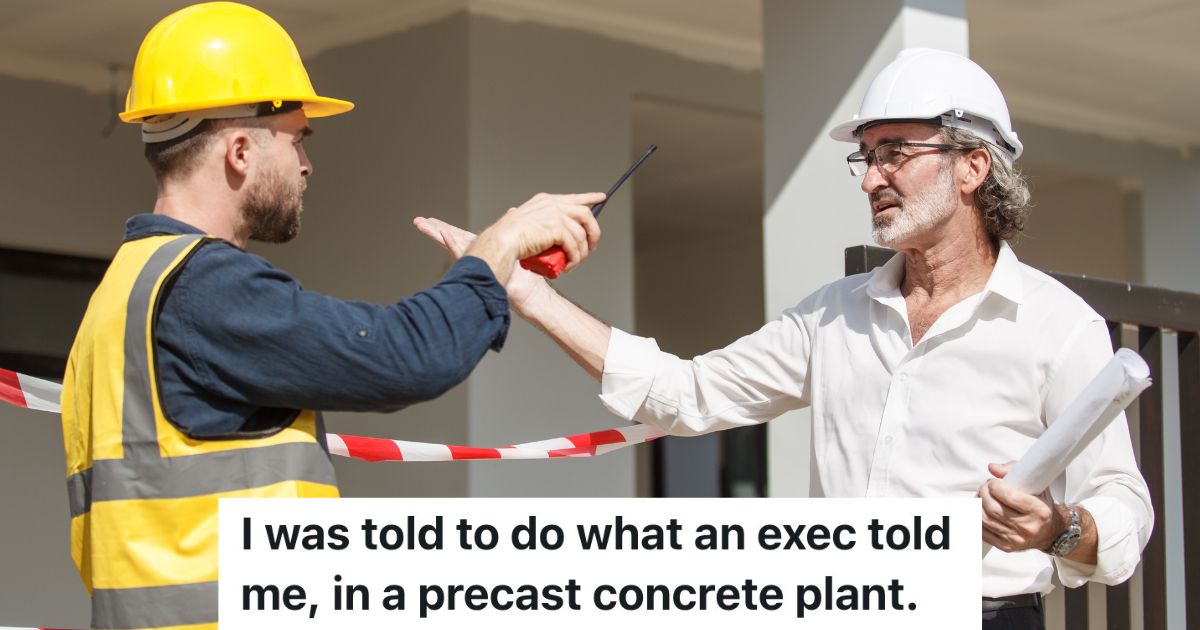
I was told to do what an exec told me, in a precast concrete plant.
Some background first.
I worked for a precast concrete company as a job in between high-school and college. The job sucked but it paid well.
We made a lot of the massive storm culverts and tunnel pieces that are dropped in place during construction instead of being made where they are.
To put this in perspective our largest casting form could handle pieces 40’x30′. Absolutely massive pieces.
He was given a new responsibility.
After a few weeks of working for this company I was trained to run the industrial concrete mixer and did this every day.
This mixer was 3 stories tall, mixed up to 4.5 cubic yards of concrete at a time, and was the most beat up machine in the entire plant, which was saying something.
It ran 6 days a week, two shifts a day, and was never maintained because the company couldn’t get techs to come out on Sunday, it’s only day not running, and didn’t want to lose a work shift to get it maintained.
The only good thing about it was that all the materials were weighed and fed in automatically. All it took was a button to start the process.
There was one really big problem.
The most common problem was the bottom release door not sealing correctly. It would be just barely cracked, allowing all the water to run out of it resulting in an unusable chunky mess that would need to be dumped in a scrap hole instead of being used.
If this happened the mess needed to be dumped out of the mixer quickly before it could partially harden inside the mixer.
This only happened once that I was there and it took an entire shift to chisel the stuff out.
We put a mark into the sliding door to show where it should be vs where it would be when it didn’t seal.
Here’s how the entire process went.
The process worked like this. A cage of rebar and anchor points was constructed on a base, around a core, and a form bolted around it. The QA guy signed off and the form was then filled with concrete and left to cure.
The curing time largely depends on the ambient temperature, the hotter it is the faster it cures and vice versa.
Once the peice has cured enough to be lifted the form is stripped and the piece lifted by crane off the core.
Repeat until you have as many pieces ordered.
Color coded hard hats seem like a good idea.
Another thing to note is hard hat colors. They were color coded according to your role. Blue are plant supervisors, green QA, red the foreman, etc.
For the ‘normal’ workers there was a choice of two colors. Yellow for people who don’t know what they are doing (typically new or dumb people) and grey for those that do.
This was about 5 months into my time with them and I had just got a grey one maybe two moths before.
Onto the story.
The owner owned two plants and thought they should be equally productive.
Our plant was starting to producing pieces at a substantially slower rate than the other plant owned by the company. We were working 10-12 hour days every day to try and make up the difference.
Typically multiple pieces were made per form, per day (2-4). We were only managing one and maybe two per form, per day.
To figure out the reason for this the owner’s plan was to send an exec from the main office to observe and time every section of the process in our plant.
This in itself was silly.
The reason was really obvious!
Remember how I said the speed concrete cures is based on temperature?
Our plant was in an unheated warehouse in a state bordering Canada, in the winter.
The other plant was in Florida.
Can you guess why production was a bit slower in our plant?
I don’t think the executive wanted to be there any more than they wanted him there.
In any case during the shift meeting before the exec got there our foreman’s exact words were “Do what he tells you, otherwise stay the heck away from him”.
Wonderful.
The shift proceeds as normal building cages and forms get bolted.
Maybe 6 hours into the shift I climb up on top of the mixer to the platform and I am greeted by the exec in the shiniest white hard hat I have ever seen… and office attire complete with black dress shoes. In an concrete plant. Lol. He looked bored out of his mind.
The executive seemed eager to leave.
He asked me something to the effect of if I was looking forwards to the end of the shift in two hours.
I told him that with no problems we might get to leave in four hours.
He got the most defeated look on his face and mumbled something that I didn’t catch.
I went through the prechecks on the mixer and found the bottom door was once again not closing properly. I yelled down to the plant supervisor that the door wasn’t sealing again and that the machine would be down until I got it to seal (normally by chipping the concrete left by the previous shift after using the mixer away from the opening).
The plant supervisor yelled back a few choice expletives directed at the mixer and stormed into his office.
The executive didn’t believe that there really was a problem.
The exec had a look and said he thought the door looked fine.
I told him that it did this a lot and that it wasn’t sealed, pointed out the mark to him, and went to get the tool I bribed a fabricator with energy drinks to make me to chip away the concrete. A breaking bar welded onto a rebar shaft that I kept under the mixer itself.
No more hunting down a air gun and and going through confined space lock and tag outs, just stand on top and poke at the concrete until the door moves freely.
Upon coming back with the tool the exec told me that the seal was fine and to “run it”.
He was told to do whatever the executive told him to do, right?
I pointed out the same things about the door nor sealing regularly, I asked if they were sure.
They replied in the affirmative.
I started up the mixer.
The mixer regularly threw a bunch of silica up into the air. With the water draining out the bottom this was going to get extra dusty. I offered them an extra mask that I had and they replied that they would be fine.
Well, it’s not my lungs.
He made sure the heavy equipment guy understood why he was running the machine.
At the same time I notice the plant’s heavy equipment guy walking into the building, and got his attention and made the hand gesture for the front loader.
I got a confused look from them and they mouthed why. I pointed down at the mixer, repeated the gesture and they threw up thier hands and turned around.
The load went into the mixer, water started draining out the bottom, dust goes everywhere. Go figure.
The plant supervisor comes out of the office i assume after seeing the giant cloud on the cameras, runs over, and says something like “OP what the heck are you doing?” (The mixer is quite loud with concrete in it, I got the general gist though).
He made sure the plant supervisor understood why he was running the machine.
I just pointed to the exec who was now covered in dust and staring at the water pouring out the bottom of the mixer.
Never said a word.
The plant supervisor’s head swiveled and he just crooked a finger at the exec.
The exec climbed down, they exited the building with the plant supervisor leading.
It wasn’t really that big of a mess.
The fallout.
The front loader was able to get to the mixer before the mess was able to partially cure inside it, so the clean up was as easy as dumping it into the bucket and then dumping that in the scrap hole and spraying out the mixer.
We continued the shift after I chipped the concrete away from the door and got it closing properly again. Not to much time wasted, maybe an hour.
The foreman asked what happened later in the shift and didn’t stop laughing for the rest of it.
At least OP didn’t get in trouble.
The plant supervisor talked to me afterwards, asked what happened, and told me he didn’t blame me for “that dummy’s mistakes” since he had said to do what the exec said.
I never saw the exec again and the plant supervisor never said what happened in the parking lot. I can only assume that the most this produced was angry phone calls, and a lot of concrete wasted.
I left about three months later but I never heard anything else about slow production times from the main office.
I kind of hope the executive didn’t get in trouble since he was giving directions out of ignorance. Hopefully the owner finally understood the problem was the weather not the employees.
Let’s see how Reddit responded to this story.
It seriously would’ve been better if the executive had just stuck to observing.


Seriously! I was hoping the executive would at least report the problem with the machine!


Another person comments on the importance of maintenance.


It seems that lack of maintenance is very common.


When you don’t know what you’re talking about, it’s better to stay quiet.
If you liked that story, check out this post about an oblivious CEO who tells a web developer to “act his wage”… and it results in 30% of the workforce being laid off.