



Canva
Starting a business can transform a family’s finances, but shared household risk turns personal ambition into a joint decision.
One truck driver sees an opportunity to buy his own rig and generate roughly four times his current gross income.
His wife has repeatedly rejected the idea without explaining why, leaving him increasingly tempted to proceed without her agreement.
Is bypassing her veto justified?
AITA for considering starting a business after my wife has told me no?
I (M29) drive truck for a living. I’m making about $90k a year and currently making about 75% of the household income.
But soon a new opportunity caught his attention.
I have the opportunity to purchase my own truck and subcontract for the company I’m with now, and gross nearly 4x what I am now, while still maintaining a similar time commitment.
Not only would starting a trucking company be fairly low risk (in this situation), but it will also bolster our wealth exponentially.
However, his wife isn’t so sure about it.
She won’t explain why she’s so against it, even after five or six conversations about it.
All I get is, “No” or, “It’s not happening.”
AITA for wanting to pull the trigger on starting a business anyway?
He felt ready to take the leap, but was it really the right decision?
Redditors weigh in with their thoughts.
If anything, his wife’s hesitation should push him to think extra critically about the venture.


Someone who actually runs a business like this chimes in with some important considerations.


This truck driver offers a cautionary tale.


If you enjoyed this story, check out this post about a man who deliberately kisses his newborn nephew while sick with a cold, going directly against the parents’ explicit wishes.
To this commenter, it doesn’t seem like this would-be business owner is properly assessing the risk.
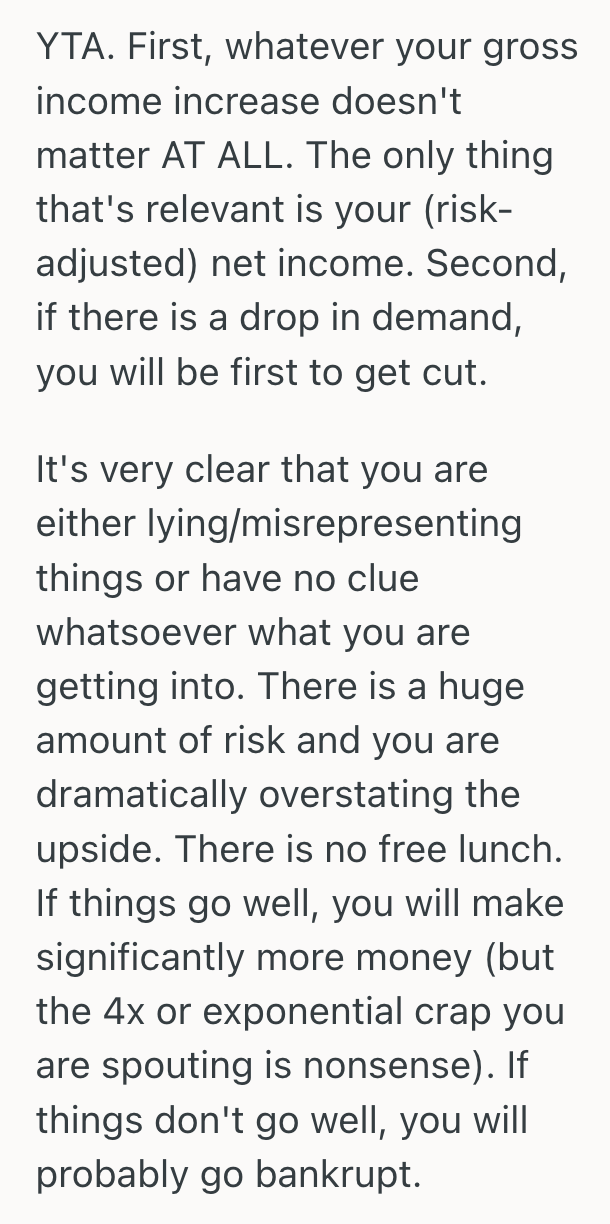

OP views purchasing the truck as a low-risk path toward greater wealth, while his wife opposes it but refuses to explain her concerns.
They need actual operating-cost projections, debt exposure, contingency plans, and an honest conversation before either enthusiasm or an unexplained veto controls the decision.
A four-times-gross promise and a one-word “no” are neither a business plan nor a functioning marriage meeting.