




Katiya Pavlova
Exploring caves can be a lot of fun, and in most cases, you will be able to see some amazing sights. When it comes to finding undiscovered areas of a cave system, however, you want to leave it to the professionals. What drives these types of professionals, however, is often the untouched treasures that sometimes wait deep within a cave.
That’s what happened in September of 2023 when explorers Adrian Beltran Dimas and Yekaterina Katiya Pavlova navigated their way deep into a flooded cave system within Mexico. Pavlova is a cave scientist (speleologist if you want to be official). She and Dimas set out to explore Tlayococ Cave, which is in the Guerrero mountains of Mexico.
The entrance to the cave is about an hour away from the nearest town, set in very difficult terrain that is home to dangerous snakes, pumas, and other obstacles that would send most people running. This team was rewarded for their bravery, but not before several other serious challenges. First, they went into the main entrance of the cave and had to travel about 150 meters (492 feet) in before they arrived at a narrow pool.
This pool had a gap of about 15 centimeters (6 inches) between the ceiling of the cave and the top of the water. Pavola commented about this experience in a statement, saying:
“I looked in, and it seemed like the cave continued. You had to hold your breath and dive a little to get through. Adrián was scared, but the water was deep enough, and I went through first to show him it wasn’t that difficult.”


Shutterstock
Once past this tight squeeze, they went on for around 30 meters (98 feet) until they had to stop because the cave ceiling came down very low, preventing them from continuing on. That is when they saw their prize. They explain:
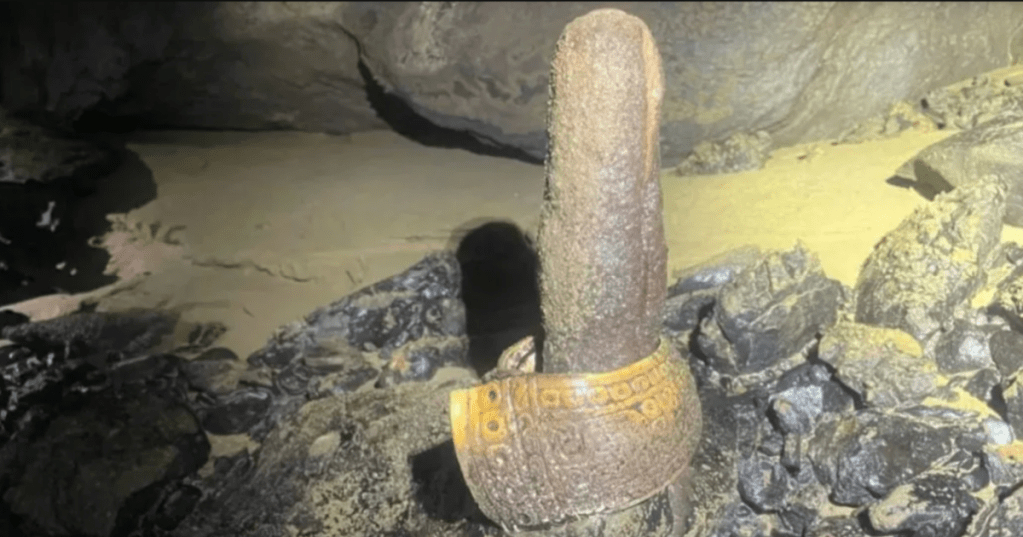
“That’s when we discovered the two rings around the stalagmites and the giant shell. The other ring was in the canal, a few meters back; we only saw it when we returned.”
The bracelets were placed directly onto a stalagmite, not unlike a ring placed on a finger. They thought it was just a piece of trash that made its way into the cave at first, but upon further inspection, they realized that it was not just a bracelet, but a very old artifact.
They notified Mexico’s National Institute of Anthropology and History (INAH). It wasn’t until March of 2025 that INAH was able to send a team of archaeologists and historians to document this amazing treasure. Upon this visit, they found three bracelets made from shells, a decorated giant snail shell, two stone disks that looked like pyrite mirrors, six more disk fragments, a small artifact of carbonized wood, and more.
Archaeologists say that the artifacts are from the Postclassic period, likely sometime between 950 and 1521 CE, belonging to the Tlacotepehua culture. They theorize that the bracelets were put on the stalagmite as part of a fertility ritual performed in the cave.
What an amazing find and quite an adventure that these two went on.
If you thought that was interesting, you might like to read about the mysterious “pyramids” discovered in Antarctica. What are they?