



Pixabay
Around three weeks after a viable human embryo is created, something called the neural plate develops.
This hardened structure eventually unfolds to become the neural tube, which itself goes on to become the early parts of the brain and nervous system.
The neural plate develops similarly across all vertebrates, and can thus be seen as the earliest stages of an organism’s brain development.
During early brain development, certain precursors to future brain and mental health conditions can start to emerge too – though our understanding of this is, at this stage, fairly limited due to the obvious complications when it comes to accessing and monitoring a three-week-old embryo’s miniscule neural plate.
But thanks to pioneering technology recently developed at Harvard’s John A. Paulson School of Engineering and Applied Sciences (SEAS), a true understanding of – and ability to monitor – the neural plate could be closer than ever.

Harvard John A. Paulson School of Engineering and Applied Sciences
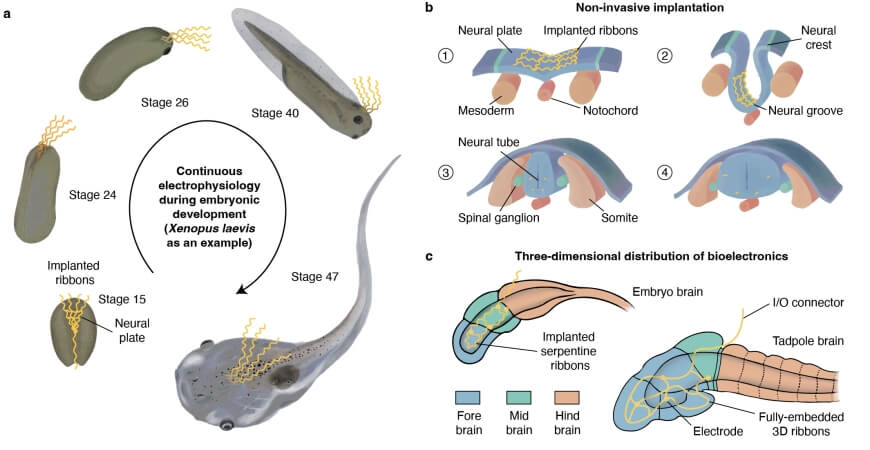
Using a soft and flexible bioelectronic device with the texture of tofu, the bioengineers have successfully implanted and monitored the neural development of tadpoles from the neural plate stage onwards.
What’s more is that unlike past attempts to insert electrodes into mature brain cells, the tadpoles seem to have been entirely unaffected by the new devices, developing normally as scientists monitored the changes in their neural cells.
This is massive, as Harvard’s Jia Liu explained in a statement:
“If we can fully leverage the natural development process, we will have the ability to implant a lot of sensors across the 3D brain noninvasively, and at the same time, monitor how brain activity gradually evolves over time. No one has ever done this before.”
In the study, which was recently published in the journal Nature, the scientists show how the new technology had no effect on the embryonic, neural, or behavioral development of the tadpoles.

Pexels
At the cutting edge of science, these ‘cyber tadpoles’ could help neuroscientists to finally understand and mitigate some of the developmental challenges that result in an array of conditions, but occur at the embryonic and early developmental stages, as Liu continued:
“Autism, bipolar disorder, schizophrenia – these all could happen at early developmental stages. There is just no ability currently to measure neural activity during early neural development. Our technology will really enable an uncharted area.”
The ultra soft and flexible implants were developed with the fragility of tadpoles in mind, after earlier studies lab-based involving stem cells.
The result was tiny sensors embedded in fluorinated elastomers, which are successfully allowing scientists and bioengineers access to the brain’s earliest and darkest developmental secrets for the first time.
Though much testing and development stands between now and a future in which human neural plates can be monitored in such a way, this study is a huge leap in a fascinating direction.
If you found that story interesting, learn more about why people often wake up around 3 AM and keep doing it for life.