


COSMOS-Web
When you look up at the stars at night, it can be astounding to remember that our individual little lives are happening not only in one tiny corner of our planet, in a tiny part of our solar system, but also in a tiny part of our galaxy, which is in itself only a tiny part of the universe.
As our knowledge and understanding of space and the universe continues to develop, with technology only enhancing our space-gazing capabilities, the real miniscule nature of our existence truly comes into perspective.
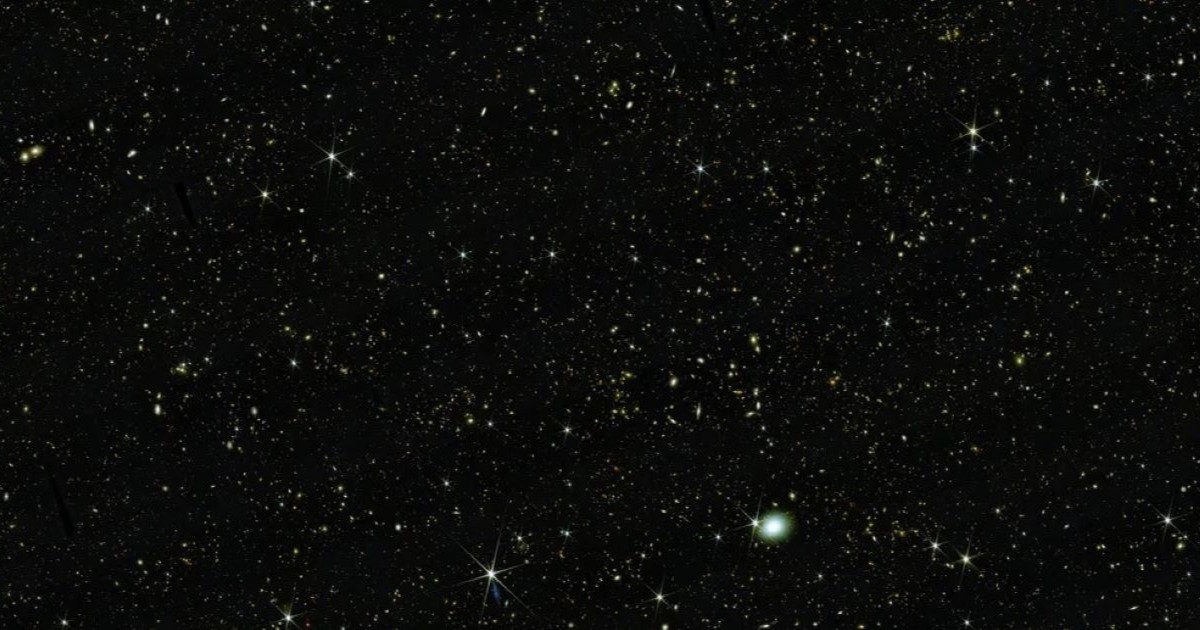
And thanks to researchers at the multinational scientific collaboration COSMOS, those truly wanting to appreciate the vastness of space in all its fascinating detail are now able to look at not only our galaxy, but 800,000 others on the interactive COSMOS-Web field.

M. Franco / C. Casey / COSMOS-Web
Comprising all the images and data that the James Webb Space Telescope has gathered to date, the COSMOS-Web field is enormous, stretching back 13.5 billion light years, almost all the way to the beginning of time.
Given that NASA hypothesise that the universe is around 13.8 billion light years old, this really does mean seeing some of the further galaxies in their infancy.
As you might expect, this means the intergalactic map is, in a word, massive, as UC Santa Barbara’s Caitlin Casey explains in a statement:
“Our goal was to construct this deep field of space on a physical scale that far exceeded anything that had been done before. If you had a printout of the Hubble Ultra Deep Field on a standard piece of paper, our image would be slightly larger than a 13-foot-tall by 13-foot-wide mural, at the same depth. So it’s really strikingly large.”
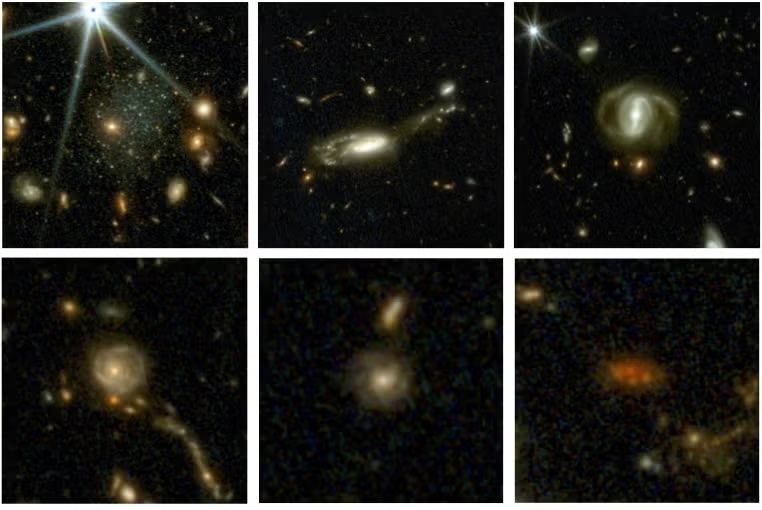
Beautiful on first glimpse, the COSMOS-Web field is astounding when the user zooms in and comprehends that each of those colorful specks is actually a star or a galaxy in action, with evident supernovae scattered throughout, one can only begin to comprehend the size of the universe that lies out there, beyond the scope of our home planet.

Pexels
Thus, the massive-scale project has the capacity not only strike awe in people around the world, but help in future scientific discoveries too, with a dataset that was entirely democratic in its access point, as Casey continues:
“A big part of this project is the democratization of science and making tools and data from the best telescopes accessible to the broader community. Because the best science is really done when everyone thinks about the same data set differently, it’s not just for one group of people to figure out the mysteries.”
With this open-access science in action, the team hope that the project will aid both budding researchers and those with a deeper insight into space to ask and answer questions around the origins and beginnings of the universe.
For the COSMOS team too, this really is just the beginning, as Casey explains:
“We have more data collection coming up. We think we have identified the earliest galaxies in the image, but we need to verify that. As a byproduct, we’ll get to understand the interstellar chemistry in these systems through tracing nitrogen, carbon and oxygen. There’s a lot left to learn and we’re just beginning to scratch the surface.”
And with new data emerging all the time, this interactive visualisation of the universe will undoubtedly aid the unlocking of countless space secrets – as well as inspiring citizen scientists for decades to come.
If you thought that was interesting, you might like to read about a quantum computer simulation that has “reversed time” and physics may never be the same.