


NASA
It is pretty rare to have an object enter our solar system, so when it happens, scientists get understandably excited and want to learn as much as they can about it. When the object named 3I/ATLAS was spotted recently, it drew extra attention because it seemed to be traveling extremely fast, which meant that is was definitely coming from somewhere outside our sun’s influence.
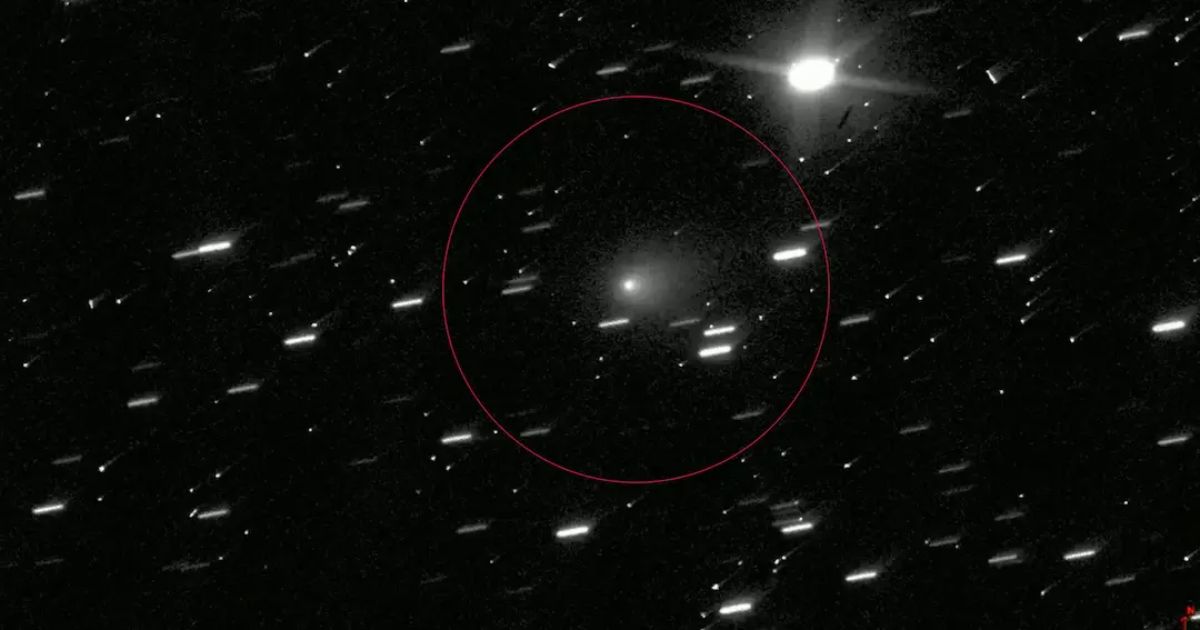
Fortunately, it was first seen while it was still a very long way away, so scientists will have plenty of time to study it. Part of that study was having the Hubble Space Telescope take some images of it, which were then compiled together by an amateur astronomer. This astronomer, who whose by the handle astrafoxen on Bluesky published the complied images with the comment:
“Plenty of cosmic rays peppering the images, but the comet’s coma looks very nice and puffy.”
This is just the third known interstellar object to ever be seen entering our solar system (Which explains the 3I part of the name). The previous objects were named Oumuamua, which was seen in 2017, and Borisov, which came in 2019 and broke apart.
One of the many exciting things about this object, which is believed to be a comet, is that it is moving so fast that it must be extremely old. These types of objects pick up speed when they are pulled in by the gravity of a star and then shot back out into interstellar space to travel on to its next destination.

Shutterstock
While a lot more research is needed to more accurately determine almost anything about this object, astronomers estimate that it must be between 3 and 11 billion years old to have reached these speeds. That means that it could be older than our solar system.
They believe that it must have originated somewhere closer to the center of the Milky Way, likely around another star. At some point, a passing star may have pulled it out of its original stellar orbit and sent it out into interstellar space billions of years ago. From there, it has traveled untold billions of miles, picking up speed along the way.
It is currently traveling at about 137,000 miles per hour, and since it is being pulled in by our sun, its speed is picking up every day. Astronomers expect that it will reach its closest point to the sun sometime around October 30th, 2025, getting within about 130 million miles of it.

Shutterstock
While it is approaching, researchers will undoubtedly take many more pictures and scans of the object using every tool at our disposal. Scientist want to answer questions such as where did this object originate, how long has it been traveling through interstellar space, where will it go next, and perhaps most importantly, is it actually an alien spacecraft.
That last question might be unlikely, but given its speed and other details, there has been some speculation that it could indeed be a spacecraft sent from another civilization. While unlikely, it is not yet something that astronomers can completely rule out, which just adds to the global attention that 3I/ATLAS is getting.
If you found that story interesting, learn more about why people often wake up around 3 AM and keep doing it for life.