


Shutterstock
There are parasites that live in almost every type of animal ranging from humans down to bugs. Each parasite works differently, with evolution working to allow them to find ways to live off of its host and reproduce for the next generation. In some cases, the parasite lives within its host its entire life, and that is where it reproduces.
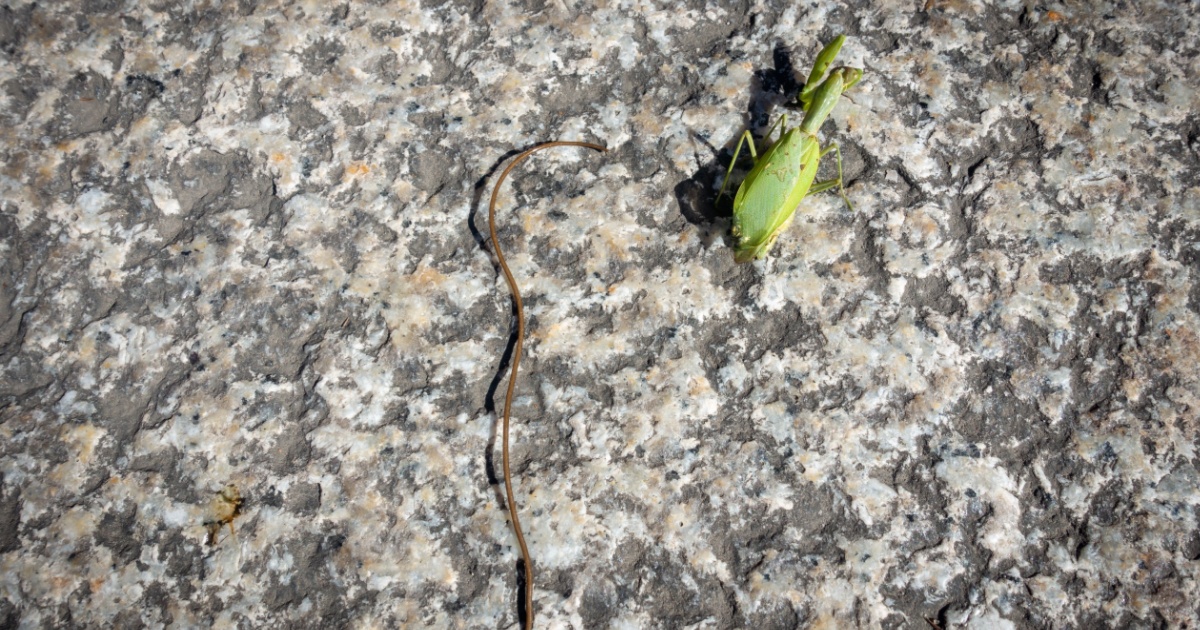
For others, however, the parasite starts its life outside of its host, finds its way in, and then has to escape again in order to reproduce. That is the case with the hairworm parasite, which is known to infect a variety of insects, including the praying mantis.
One weird thing about this parasite is that it starts out its life in a river or other body of water, and it needs to get back to a body of water to reproduce. The problem is that they spend most of their life inside of an insect that typically doesn’t like to jump in the water because that is where fish and other predators can easily capture them (or they can drown).
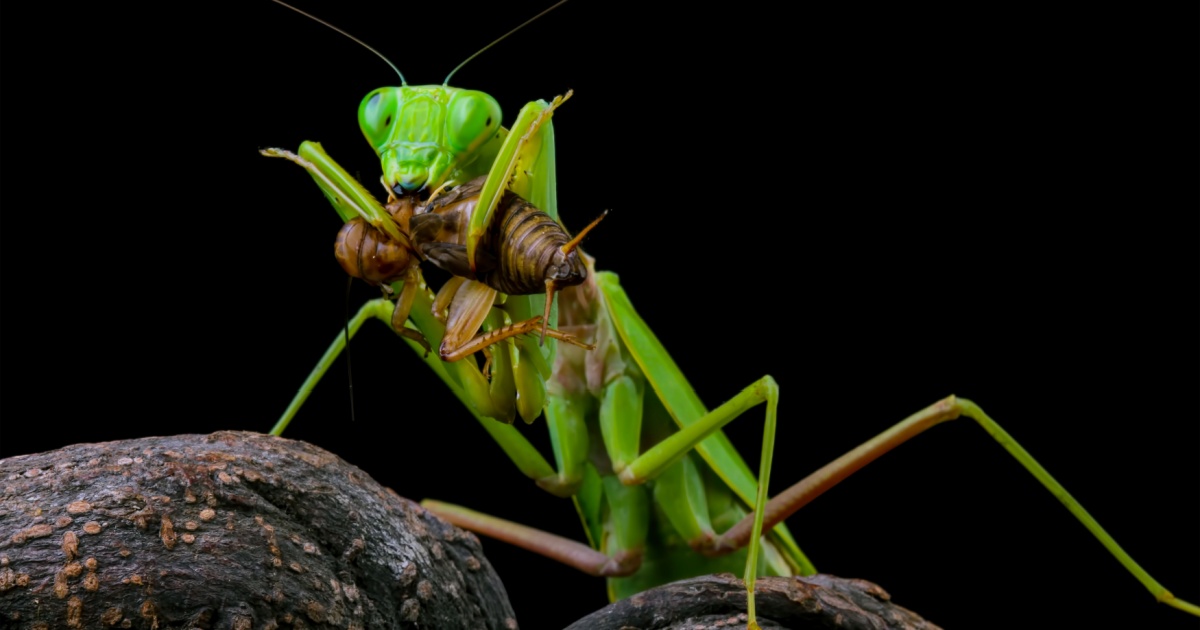
Their life cycle has been known for a long time, and progresses like this: First, they are born in the river where they live in the water until a small aquatic insect larva eats them. When the insect develops wings and leaves the water, the parasite goes with them. In some cases, that insect will be captured by a larger insect like a praying mantis, and when that happens, the parasite will live and grow within the mantis for some time.
Once the parasite reaches maturity, it needs to find its way back to water. To do this, it manipulates its host to jump into the water, despite the fact that going into the water often means death for the insect.
To accomplish this seemingly unnatural action, the parasite somehow manipulates the neurological pathways to get it to want to go toward polarized light, which is found in the type of water where it wants to go.
The researchers published a paper in Current Biology that describes why they believe that it is this specific type of polarized light waves that are desired.
Shutterstock
It has long been known that many insects find water by looking at the brightness of the light that reflects off of it, so it was assumed that this is what the hairworm made its host attracted to. It turns out, that was only partially correct. After all, there are many bright areas in nature, and even many areas of water (such as puddles) that would not be ideal.
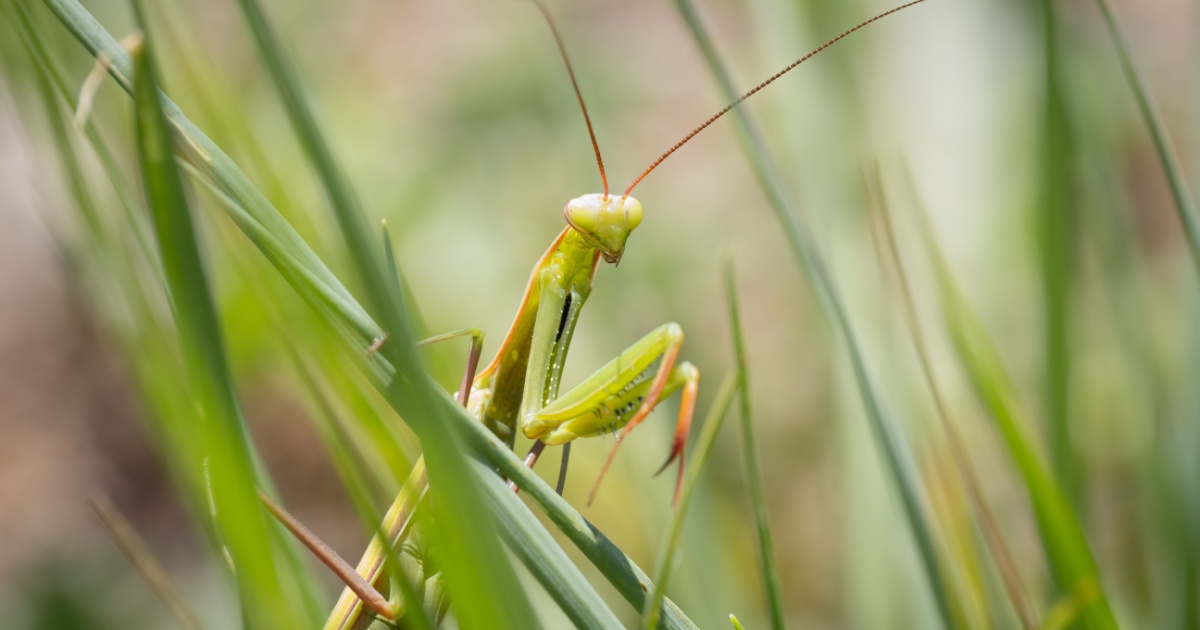
Light that reflects off of water is mostly polarized horizontally, so the researchers took a tube and made it so the light coming out of one end was polarized horizontally and the other end was not polarized at all. A mantis was then put in the middle of the tube and observed.
If the mantis was infected with the hairworm parasite, it was more likely to move toward the polarized light than if it was not infected.
Armed with that knowledge, the researchers set up a more advanced experiment. They had an area with two pools of water. The first one was deep and dimly reflected horizontally polarized light. The other was shallow and only had a weakly polarized reflection. In the middle, there was a tree where they placed 31 infected mantis and 19 uninfected.
Shutterstock
Sixteen of the infected praying mantis ended up in the water, with 14 of them going to the horizontally polarized light water source. Only one of the uninfected insects went into the water, further showing that the parasite indeed does encourage this behavior.
Additional research will be needed in order to identify the exact neurological condition that the parasites cause to drive the insects toward the water, at least now they understand how it works, so they will better know what to look for.
If you thought that was interesting, you might like to read a story that reveals Earth’s priciest precious metal isn’t gold or platinum and costs over $10,000 an ounce!