


Pexels/Reddit
Loyalty programs were designed to reward customers, not punish cashiers.
After repeated pressure to hit impossible sign-up targets, one liquor store employee chose the busiest shift imaginable to follow management’s rules word for word.
What happened next proved that compliance could be its own form of protest!
Keep reading for the full story.
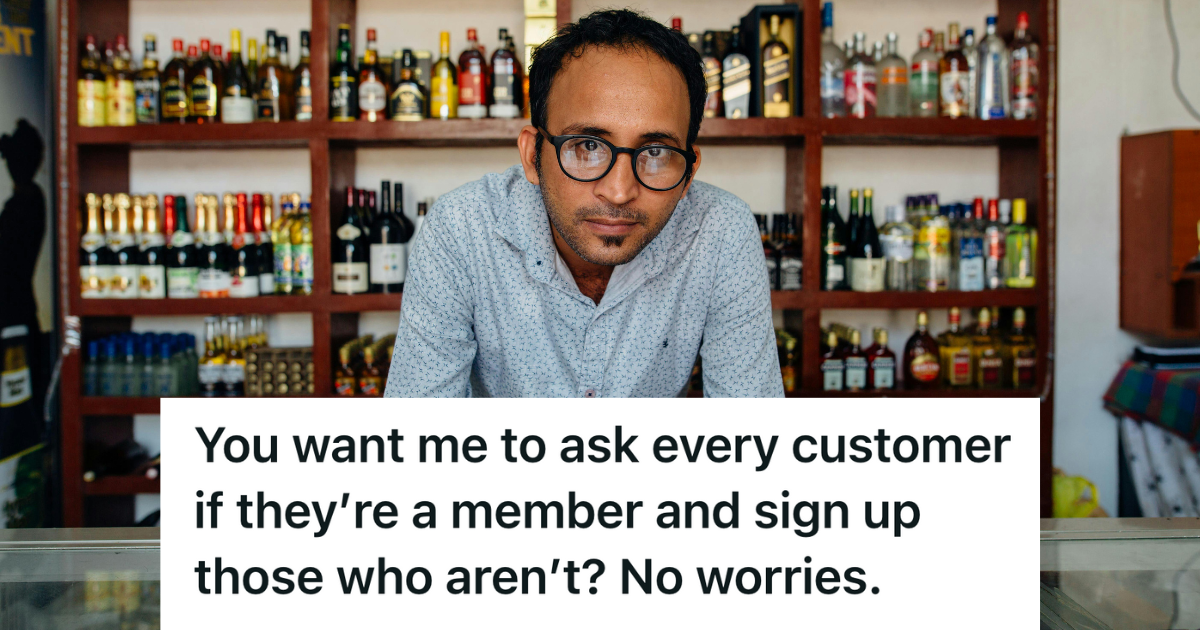
You want me to ask every customer if they’re a member and sign up those who aren’t? No worries.
I work in a relatively large liquor store, and we have the worst and most pedantic middle management I’ve ever worked for.
They sent an email to all stores in the state demanding to know why customers weren’t being signed up for our loyalty program.
This cashier explains why this idea just doesn’t work in practice.
You could tell these middle managers had never actually worked in a store, as they expected us to ask every single customer if they were a member and, if they weren’t, to sign them up for the loyalty program.
Also, if a member didn’t have their card, we were expected to look them up manually.
This can take a long time, as sometimes customers give you an old address, and the system only allows you to look up customers with a current surname and postcode.
So the cashier decided to use their better judgement and continue with their shift, but management insisted.
I ignored the email and continued to serve people as normal. I would always remind our regulars to get out their card so they wouldn’t miss out on getting their loyalty points, and would occasionally sign people up when the shop was quiet.
Cue follow-up emails and a talking-to from the store manager.
“You have to sign up at least five people a day!”
So this cashier picked the best possible shift to finally comply.
Fast forward to Christmas Eve. Our store was understaffed, and the area manager was coming around to each store in the area for an hour or so, just to see how the stores were doing on such a busy night.
I decided now was the perfect time to ask each and every customer, “Are you a member of our loyalty program?”
If yes, but they didn’t have a card: “No worries, let me just look you up. It won’t take a second!”
If they weren’t a member: “Would you like me to sign you up for the program?”
Signing up wasn’t exactly a quick feat — and the cashier knew this all too well.
For context, signing people up manually takes approximately three to five minutes. It would take them the same amount of time to sign up themselves on the App Store at home, but I would never tell them this.
So we had a queue snaking through the length of the store. People were getting impatient, but because they thought I was just being helpful, no one got mad at me.
Finally, management noticed chaos was building.
The area manager, who had been doing next to nothing—just walking around checking we had the correct tickets up—suddenly came up to me.
He was super flustered and said, “Why are the transactions taking so long? This line is getting ridiculous.”
The cashier was quick to fill the manager in.
I told him calmly, while slightly playing dumb, that I was just following management’s directive to make sure we were asking every customer for their loyalty card and signing up those who weren’t members.
He told me that “there’s no time for that, just serve them quickly!”
So I said, “But we’ve been told to sign up five people a day, by you.”
Finally, management is forced to go back on their word.
At this point, he was red in the face and just blurted out, “Just serve and forget about the loyalty program.”
So I didn’t ask a single customer for their card or sign up any new members on that shift.
And I haven’t since.
Plus, management has never mentioned it again.
This program ended up staying on paper, right where it belonged.
What did Reddit think?
Bad management is often the nail in the coffin for many already struggling businesses.


This former salesperson shakes their head about just how much the state of business has changed.


The people in charge often have absolutely no idea how the real operations of the store work.


When businesses are too pushy about loyalty, they end up losing customers.


By the end of the shift, the line was gone and so was management’s enthusiasm.
Sometimes the easiest way to stop a bad idea is to let it run wild.
If you liked that post, check out this story about a customer who insists that their credit card works, and finds out that isn’t the case.