


Shutterstock
The LIGO-Virgo-KAGRA Collaboration has been recording gravitational wave observations for a decade now, and in 2024, it detected two that seem to be unique.
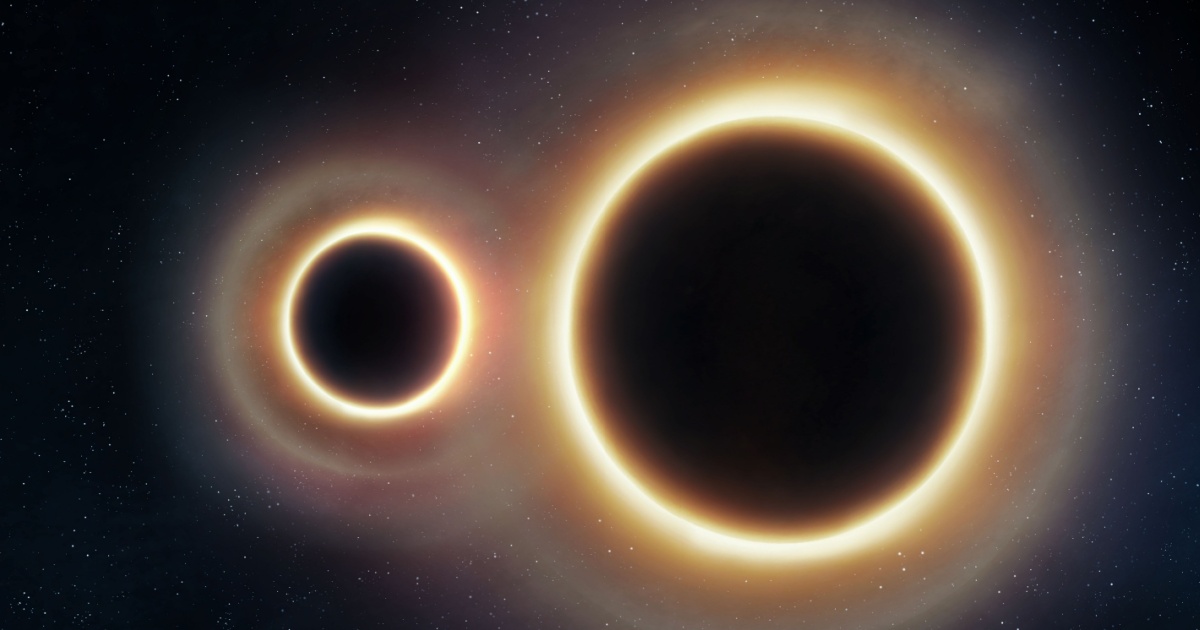
The first one, dubbed GW241011, was detected on October 11, 2024, and it was found that it was the result of a collision of two black holes. The two black holes were 17 and 7 times more massive than our sun, and the event took place about 700 million light-years away.
What sets this event apart from others is that the spin of the more massive black hole was fast. In fact, it was the fastest-spinning black hole ever detected, coming in at around 75% of the theoretical maximum spin speed.
The second event, called GW241110, was also from two black holes, this time one that is 16 times more massive than the sun and another that is 8. Normally, black holes orbit each other before merging, and during that process, they spin in the same direction. In this case, however, the larger black hole was spinning in the opposite direction, which has never been seen before.
Both of these events indicate that the larger black holes in each case were likely the product of a previous black hole merger.
Having gone through previous mergers makes them (at least) second-generation black holes, providing researchers with lots of interesting data to study. Stephen Fairhurst is a professor at Cardiff University and the spokesperson of the LIGO Scientific Collaboration.
In a statement about the events, he said:
“GW241011 and GW241110 are among the most novel events among the several hundred that the LIGO-Virgo-KAGRA network has observed. With both events having one black hole which is both significantly more massive than the other and rapidly spinning, they provide tantalizing evidence that these black holes were formed from previous black hole mergers.”

Shutterstock
Gianluca Gemme is a spokesperson of the Virgo Collaboration, and added:
“These detections highlight the extraordinary capabilities of our global gravitational wave observatories. The unusual spin configurations observed in GW241011 and GW241110 not only challenge our understanding of black hole formation but also offer compelling evidence for hierarchical mergers in dense cosmic environments: they teach us that some black holes exist not just as isolated partners but likely as members of a dense and dynamic crowd. These discoveries underscore the importance of international collaboration in unveiling the most elusive phenomena in the universe.”
A paper about these events was written and published in The Astrophysical Journal Letters, offering insights not only into what they mean but also how the researchers were able to determine that the larger black holes were the result of a merger.
If you thought that was interesting, you might like to read about a second giant hole has opened up on the sun’s surface. Here’s what it means.