


NASA
The closest that coronal mass ejections (CMEs) come to most people’s awareness is when they’re mentioned as a cause of unseasonable or unusually widespread displays of the aurora borealis, or Northern Lights.
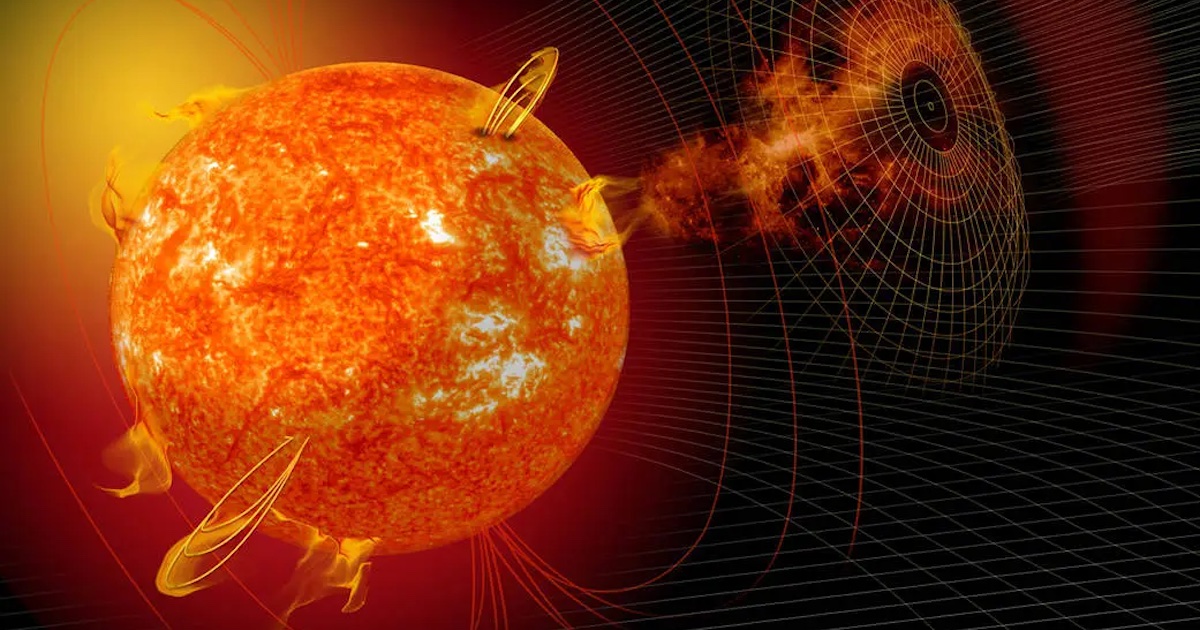
They sound dramatic and they are dramatic: during a CME, the star (in our case, our Sun) hurls out burning material (plasma) into space, which travels through space, affecting the magnetic fields of nearby planets.
Here, the magnetic fields send the particles (known as solar wind) toward the poles, resulting in borealis as the charged particles interact with the planet’s atmosphere, while geomagnetic storms can affect satellites and communications systems too.
Until recently, CMEs had only been observed on Earth from our Sun, but recently researchers happened across something quite incredible.


Pexels
In a paper published in the journal Nature, researchers explained that, thanks to a Low Frequency Array (LOFAR) radio telescope, they’ve detected a CME from another star – in this case a red dwarf – for the very first time, and from 130 light years away.
This is fascinating news, as the Netherlands Institute for Radio Astronomy (ASTRON)’s Joe Callingham explained in a statement, breaking new ground for astrophysics:
“Astronomers have wanted to spot a CME on another star for decades. Previous findings have inferred that they exist, or hinted at their presence, but haven’t actually confirmed that material has definitively escaped out into space. We’ve now managed to do this for the first time.”
This is all thanks to the energy of a CME travelling through space which, understandably, causes intense radio waves, which the radio telescope was able to detect.

Pexels
Thanks to the radio telescope and their other measurements, the researchers were able to determine that the CME was moving at 2,400 kilometers per second, much faster than the majority of the Sun’s CMEs.
And given the danger that this would present to life on other planets, that could effectively be razed by the CME, this understanding of space weather is going to be fundamental as we continue to explore possible other habitable planets. As this goes on, this kind of technology could be at the forefront, as the European Space Research and Technology Centre (ESTEC)’s Henrik Eklund continued:
“We’re no longer limited to extrapolating our understanding of the Sun’s CMEs to other stars. It seems that intense space weather may be even more extreme around smaller stars – the primary hosts of potentially habitable exoplanets. This has important implications for how these planets keep hold of their atmospheres and possibly remain habitable over time.”
This is vital information as we work to understand where in life we could live, and where other life could exist. After all, while our atmosphere is great at protecting us from CMEs, that is not the case everywhere.