



Shutterstock
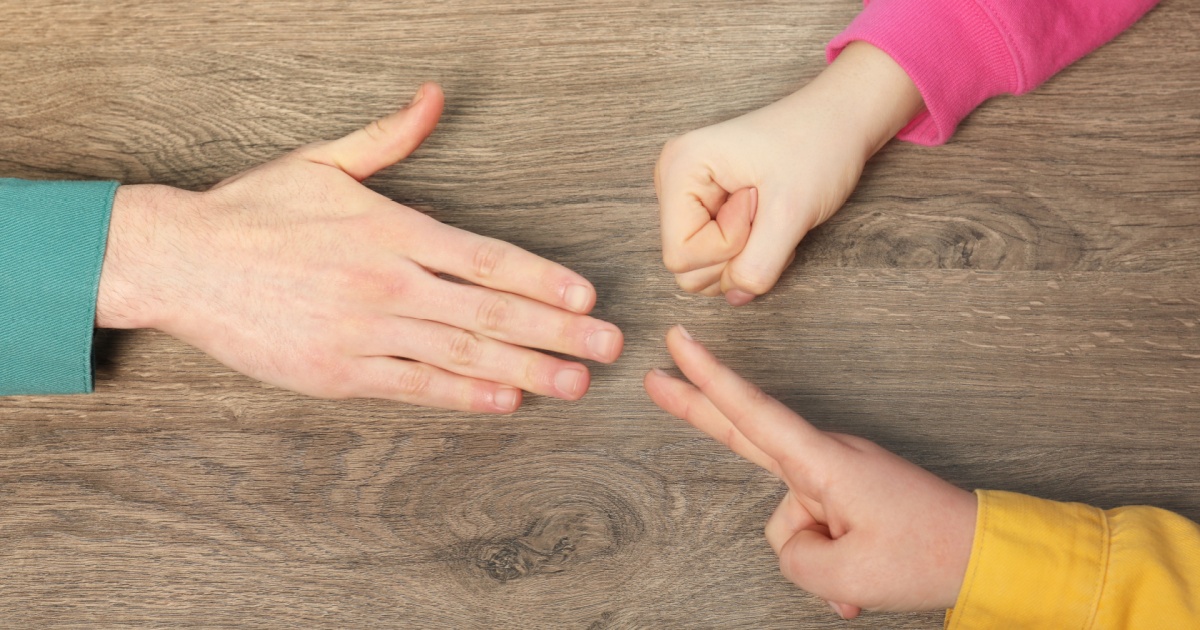
Rock-Paper-Scissors is one of the oldest and most popular games out there. It is used not just for fun, but also to make various decisions when two or more people disagree on something. For kids and adults alike, it is generally viewed as a way to end a debate once and for all, with everyone honoring the outcome.
The game is simple, but it is also loved because it is pretty much a game of pure chance, right? After all, each option in the game has equal odds of winning, losing, and tying. Interestingly, whether you are actually trying to win or actively trying to lose, you should have the same odds.
With all that being true, one might wonder why there are actual rock-paper-scissors leagues and tournaments. Shouldn’t each player win the same number of times just by random chance?
Well, not exactly.
While there is no way to win 100% of the time, there are strategies that can greatly improve your odds, especially if you are playing against someone who doesn’t know the strategies. Understanding the different tactics that are used by the pros can help you to win more than the odds should allow.
The first method is to play completely randomly.
You might think that this is what you are already doing, but it almost certainly is not. Humans are anything but random. We even see patterns where none exist, and our affinity for patterns is even more significant when making decisions. Denise Morerel, Manuel Varlet, and Tijl Grootswagers are cognitive neuroscientists at Western Sydney University. They published an article in The Conversation on this very topic, and in it, they said:
“There’s an optimal strategy for winning multiple rounds of rock, paper, scissors: be as random and unpredictable as possible. Don’t pay attention to what happened in the last round.”
Shutterstock
This advice is much easier said than done because our brains are experts at analyzing data and making quick decisions when needed.
Those decisions, however, are not random and are influenced, often subconsciously, by many factors. If you can find a way to be truly random, or at least more random than the other player, however, you can increase your odds.
This is according to a study they published on the subject. They explained how what they learned:
they…”asked people to play 15,000 games of rock, paper, scissors while recording their brain activity. Our results […] found that those who were influenced by previous rounds really did tend to lose more often.”
In the event that both players are able to play perfectly randomly, it would still result in winning 1/3 of the time, losing 1/3 of the time, and coming to a draw 1/3 of the time, which isn’t bad at all.
The second strategy that is often used is trying to analyze your opponent and adjust your choices.
This method was developed in 2014 after following 360 students playing the game against their peers for money. The research was done at China’s Zhejiang University. Hannah Fry, a Professor of the Public Understanding of Mathematics at the University of Cambridge and president of the Institute of Mathematics and its Applications commented on the study in a video, saying:
“In recording what these students did […] the scientists came up with two quite important findings of how people try to beat each other. The first one is that people who win tend to repeat their strategy. So, for example, if I beat you by playing rock, there is a very high chance […] that I will play rock again the second time. If it worked once, it’s going to work again, right? Another way to say it is [that] you’ve just played scissors, they’ve played rock, so play the thing that didn’t come up.”
And finally, a third strategy is to try to influence the other player to do what you want them to do. While it sounds silly on the surface, people can be manipulated quite easily, especially in situations where the outcome isn’t critical.
William Poundstone is the author of How to Predict the Unpredictable: The Art of Outsmarting Almost Everyone. He comments:
“Trash talk is allowed in most tournaments most good players believe in tells. When a suitable situation arises, you say, ‘Hey, let’s do rock, paper, scissors for it!’ Without waiting for an okay, begin pumping your fist. The usual preference for rock is greatly enhanced when the player doesn’t have time to think.”
Graham Walker is a co-author of The Official Rock Paper Scissors Strategy Guide and a five-time organizer of the World Rock Paper Scissor Championship, and in 2006, he wrote:
“When playing against someone who asks you to remind them about the rules, take the opportunity to subtly ‘suggest a throw’ as you explain to them by physically showing them the throw you want them to play. Paper beats Rock, Rock beats scissors (show scissors), Scissors (show scissors again) beats paper.”

Shutterstock
He explained how this works:
“Believe it or not, when people are not paying attention their subconscious mind will often accept your ‘suggestion.’ A very similar technique is used by magicians to get someone to take a specific card from the deck.”
At the end of the day, there is no way to guarantee yourself a win, but when playing games that at least mathematically are pure luck, even small changes to your odds can make a big difference.
If you thought that was interesting, you might like to read a story that reveals Earth’s priciest precious metal isn’t gold or platinum and costs over $10,000 an ounce!
If you thought that was interesting, you might like to read a story that reveals Earth’s priciest precious metal isn’t gold or platinum and costs over $10,000 an ounce!