


Pexels
There’s plenty to marvel at about chameleons: the lizards with an astounding ability to match their skin color to their environment, in an impressive (and convincing) attempt to hide from predators’ eyes.
But perhaps the second most fascinating thing about chameleons is their eyes.
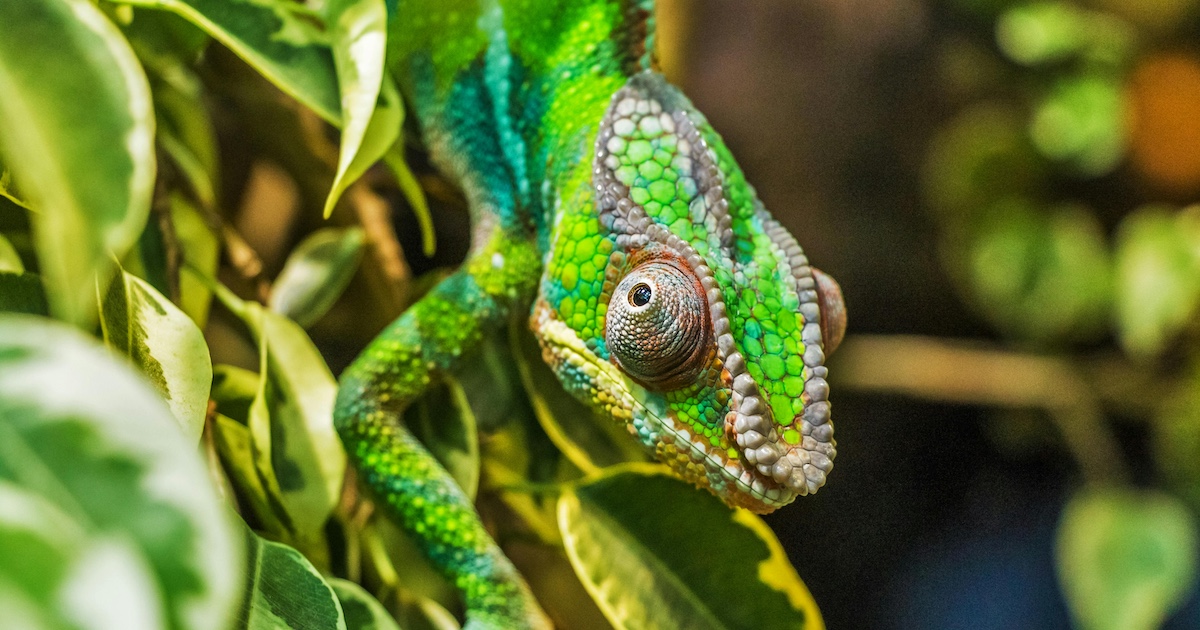
These lizards are able to move each eye independently, allowing them a close to 360-degree view of their surrounds – and, crucially, their quick-moving prey.
And thanks to a new study, researchers have finally understood exactly how these incredible creatures move their eyes in such a striking and unique way.


Pexels
Using an interdisciplinary approach, with CT scans and existing data, the scientists were able to see for the first time exactly how a chameleon’s eyes swivel independently, without ever crossing.
And the secret lies in their unique, coiled optic nerves, which look not unlike an old telephone wire, as Sam Houston State University’s Juan Daza explained in a statement:
“Chameleon eyes are like security cameras, moving in all directions. They move their eyes independently while scanning their environment to find prey. And the moment they find their prey, their eyes coordinate and go in one direction so they can calculate where to shoot their tongues.
Remarkably, the team explained in their paper – which was recently published in the journal Scientific Reports – that the chameleons’ optic nerves, and thus their ability to swivel their eyes in that unique way, is fully developed by the time a baby lizard hatches.


Pexels
One of the most surprising things about the revelation, the scientists explained, was the fact that it had never been discovered before. But as Daza continued to explain in the statement, this is all down to the methods used to study them, since other approaches – like dissecting a deceased creature – don’t allow for the live motion of the eye to be observed:
“These digital methods are revolutionizing the field. Before, you couldn’t discover details like this. But with these methods, you can see things without affecting the anatomy or damaging the specimen.”
And live CT scanning helped the researchers to understand why the lizard’s eyes have evolved in such an unusual way. Chameleons have a limited range of motion in their necks, the adaptations to their eyes have helped them to see more than ever before:
“The first phones just had a simple, straight cord attached to the headset, but then someone had the idea to coil the cord and give it more slack so people could walk farther while holding it. That’s what these animals are doing: They’re maximizing the range of motion of the eye by creating this coiled structure.”
Not only is this adaptation fascinating, it shows just how smart evolution really can be.
If you thought that was interesting, you might like to read about why we should be worried about the leak in the bottom of the ocean.