



Shutterstock
Whether the temperatures are dropping outside or you’re placing ice cube trays in the freezer, everyone knows that once water drops to 0°C (32°F), it will freeze.
This is because, as the heat energy leaves the water, the atoms and molecules slow down and condense closer together. Maxim Lavrentovich is an Assistant Professor of Theoretical Biophysics at the University of Tennessee, and he explained what is happening:
“Whether in plants and animals or rocks, foams and ice crystals, the intricate patterns that happen in nature come down to what’s happening at the level of atoms and molecules. When water freezes, its molecules begin clustering together. Water molecules have a particular bent shape that causes them to stack into clusters shaped like hexagons as they freeze.”
It is this crystalline pattern that allows all water (with a few odd exceptions) to freeze at the set temperature.
This is not the case for all materials. Molecules of oil, for example, do not form the same clean crystalline shapes as the temperature goes down.

Shutterstock
This means that, unlike water, most oils do not freeze at a set point. Instead, they will become more and more viscous the colder they get. Even when oil is so cold that it seems solid, it is still not frozen in the same way that water is.
The University of Illinois Urbana-Champaign explains what is happening in these cases:
“Eventually, if you get it cold enough, the oil will seem to be quite solid, as the molecules lose the energy needed to move around. In that sense, you can say that oil does in fact freeze, but it has no sharply defined freezing point, like water. Glass is similar, in that it gets soft and eventually quite fluid as it is heated, but there is no one sharp melting temperature. The molecules get stuck when cold, but not in any simple regular arrangement.”
This is much more than just an interesting science fact that could win you points on trivia night. Most people experience the results of oil’s properties on a daily basis.
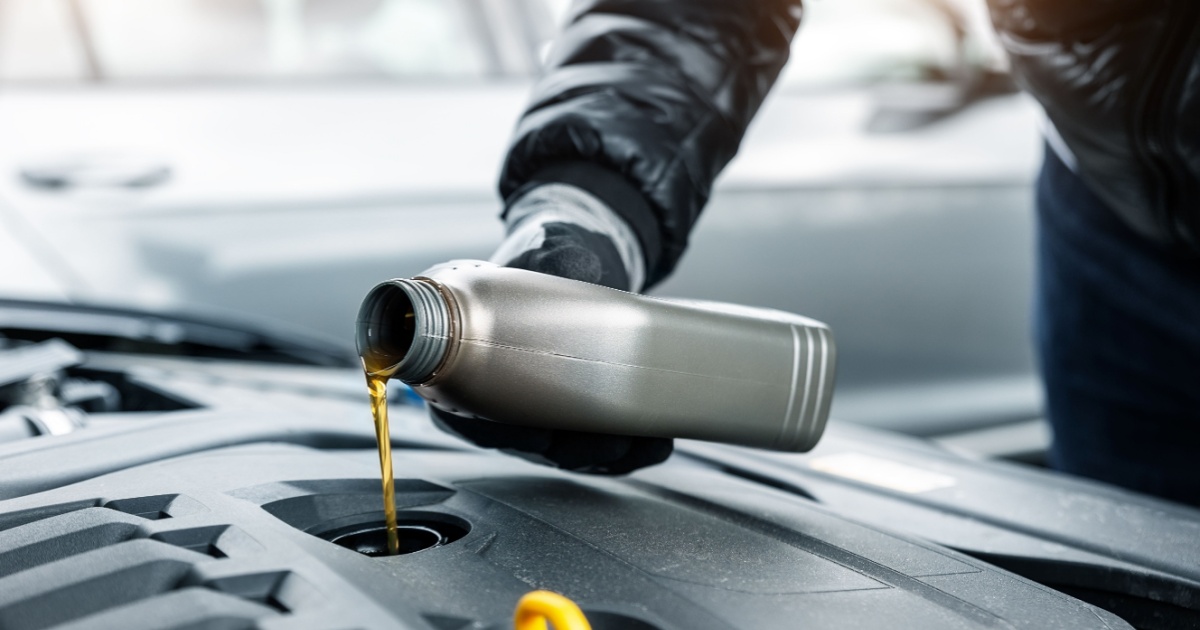
Your car engine (and millions of other products that require lubrication) uses oil to reduce friction. If oil froze in the same way that water does, when the temperatures outside hit a certain point, trying to start your car would be impossible, as the oil would freeze it up.
Of course, in very cold weather, the oil does become thicker and more viscous, which means your car’s engine has to work harder to get things moving than it would in hot weather. This can even result in slight damage to the internal parts of the engine, especially if you start your vehicle and immediately start driving aggressively.
Shutterstock
Fortunately, modern engines heat up quickly and bring the temperature of the oil up to a safe level. It is, however, recommended that you let your car run for a minute before driving in extremely cold temperatures, and for the first several miles of driving, you accelerate more slowly than normal to help minimize any negative impact.
The science behind oil and how it reacts to temperature is incredible.
If you thought that was interesting, you might like to read a story that reveals Earth’s priciest precious metal isn’t gold or platinum and costs over $10,000 an ounce!