


Pexels
In the Western world, there is a sad truth in that when we break things, we tend to just throw them away and replace them.
That’s the result of a throwaway society in which (in recent memory, at least) things were so cheap that it wasn’t worth the hassle to mend them.
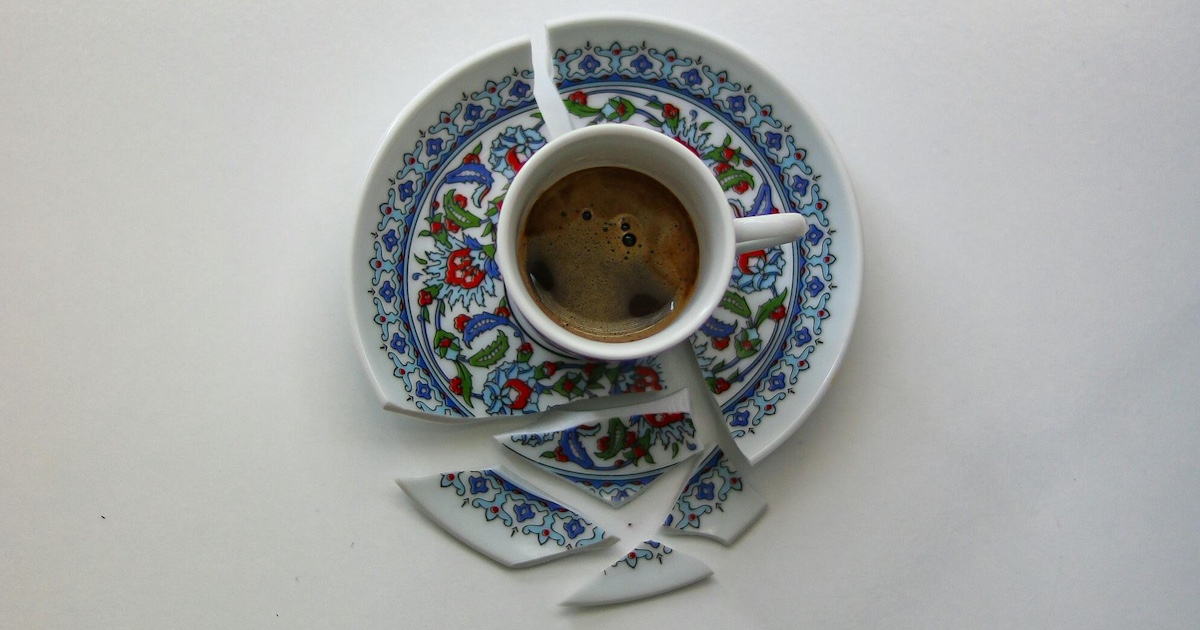
Whether we’re faced with a broken plate or a broken heart, we would all do well to reflect upon the Japanese practice of Kintsugi, in which broken objects are repaired with golden joinery, in a method that instead of hiding the break actually highlights it, makes it more beautiful.
There is beauty in imperfections, in things that have been broken and put back together, the practice gently shows. Sometimes we could all do to remember that.


Pixabay
Because it is inevitable that things – even the things we hold most dear – will get broken. And whether it’s your own clumsiness, a child or a pet, or just the strangest happenstance that leads to your favorite vase getting broken, perhaps that isn’t its end, just the beginning of a new stage in its life.
Kintsugi might, at first glance, look like a scrambled mess of pieces interwoven by gold. But with inspection you can see the meticulous care that has gone into taking each fragment and painstakingly fixing it back into place.
Those fragments might seem like they are totally random in the pattern of their breaks, and indeed, each piece of Kintsugi is unique in its perfect imperfections.
But according to a new study by French researcher Emmanuel Villermaux, the fragmentation is actually entirely predictable – mathematically so, at least.

Pexels
In the study, which was recently published in the journal Physical Review Letters, Villermaux explains that we can predict the mechanics of exactly how a particular object will fragment, all based on statistical analysis.
Many factors come into this, including the specific material of the object, and the event that leads to its fragmentation – but importantly, the distribution of small and large fragments is not entirely random.
And – according to the study’s many experiments and models – the predictability can be applied from the smallest to the largest of solid objects in our universe, with implications for how we clean up broken sugar cubes to how we blast apart oncoming meteors.
Sadly, though, Villermaux’s paper has little advice for your broken heart.
Thought that was fascinating? Here’s another story you might like: Why You’ll Never See A Great White Shark In An Aquarium