


Shutterstock
Communication today is pretty amazing. You can be almost anywhere on the planet and communicate globally using satellites, underwater cables, and relay systems that are extremely reliable.
This was not always the case.
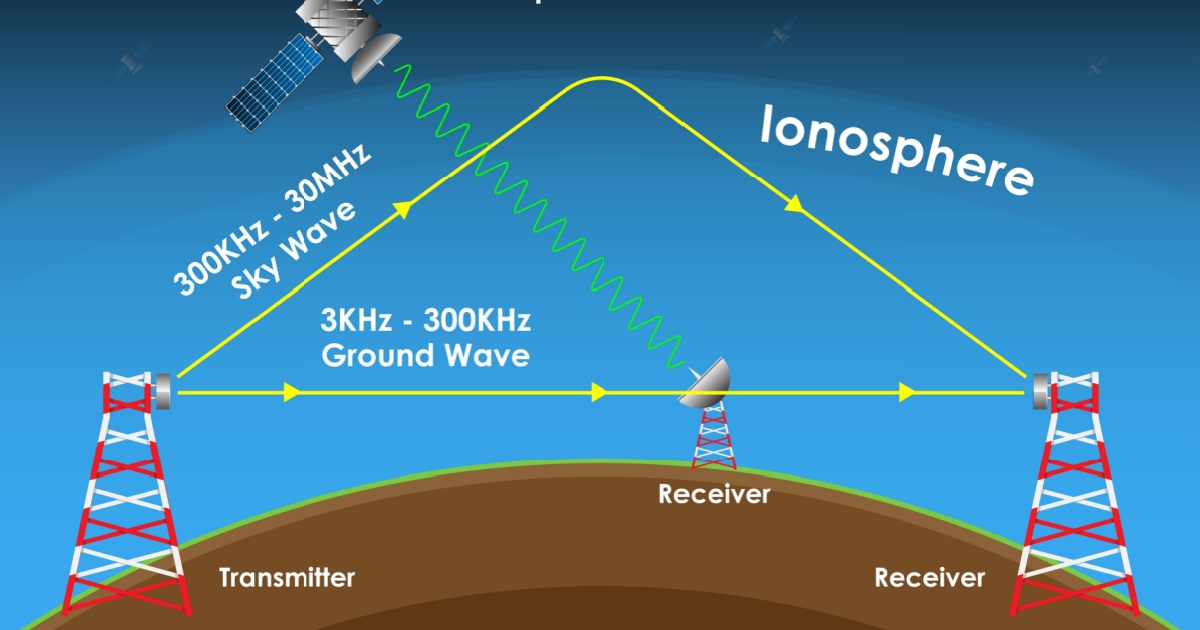
During the Cold War, communicating to places on the other side of the world could really only be done in two ways. The first was underwater cables that go across the ocean, and the other was to bounce communication signals off of the ionosphere of the Earth. The ionosphere is a charged layer of the Earth’s upper atmosphere.
Both of these options worked well, but it was believed that they could also be disrupted by the enemy. Cutting underwater cables is easy, and the US Military thought that Russia would be able to disrupt communication via the ionosphere as well.

Shutterstock
So, in 1961, the US Military worked with the Massachusetts Institute of Technology (MIT) to find a third option that would be more reliable. This led to Project West Ford, which was an attempt to create an artificial ionosphere by launching millions of tiny copper needles called dipoles into orbit around the planet.
Once in place, they could be used to reflect radio signals to allow for critical communication.
The first attempt failed when the needles didn’t release as planned, but the second attempt used a naphthalene gel that evaporated in space, leaving between 120 and 215 million copper needles orbiting the Earth.
The needles would slowly spread out until they formed a ring around the Earth. Donald MacLellan is a former assistant director of MIT’s Lincoln Laboratory. He explained how it should work:
“Successful link operation would require high-gain (0.15° beam) antennas, high-power transmitters, and sufficient numbers of energy scattering dipoles to be present in the common volume of space where the transmit and receiving beams overlapped in the dipole belt. Received signals would have nasty characteristics – spread in frequency and time delay by the differential orbital velocities and positions of the dipoles dispersed in the belt.”
The test was a success and was confirmed to be able to transmit voice, text, and data between points in Massachusetts and California. If a full deployment had been made, it could have facilitated global communication.
You can see more about how this system worked in this video:

Fortunately, the invention and deployment of communication satellites made this project obsolete.
The copper needles were designed to deorbit themselves within a relatively short period of time and burn up in the atmosphere, which is what happened to most of them. Some of the needles, however, clumped together and still haven’t deorbited. NASA is tracking 46 clumps of these copper needles that continue to orbit the planet.
They are keeping an eye on their orbit to ensure that they don’t cause any problems by running into satellites. Eventually, their orbital decay will be enough that they too will burn up in the atmosphere.
If you thought that was interesting, you might like to read a story that reveals Earth’s priciest precious metal isn’t gold or platinum and costs over $10,000 an ounce!