


Shutterstock
When it comes to studying outer space, there is plenty to learn. Of course, for most people, looking for aliens is about the coolest thing that can be done.
The Breakthrough Listen Galactic Center Survey is part of a scientific research program that looks at radio waves from space with the hope of finding evidence of alien civilizations.
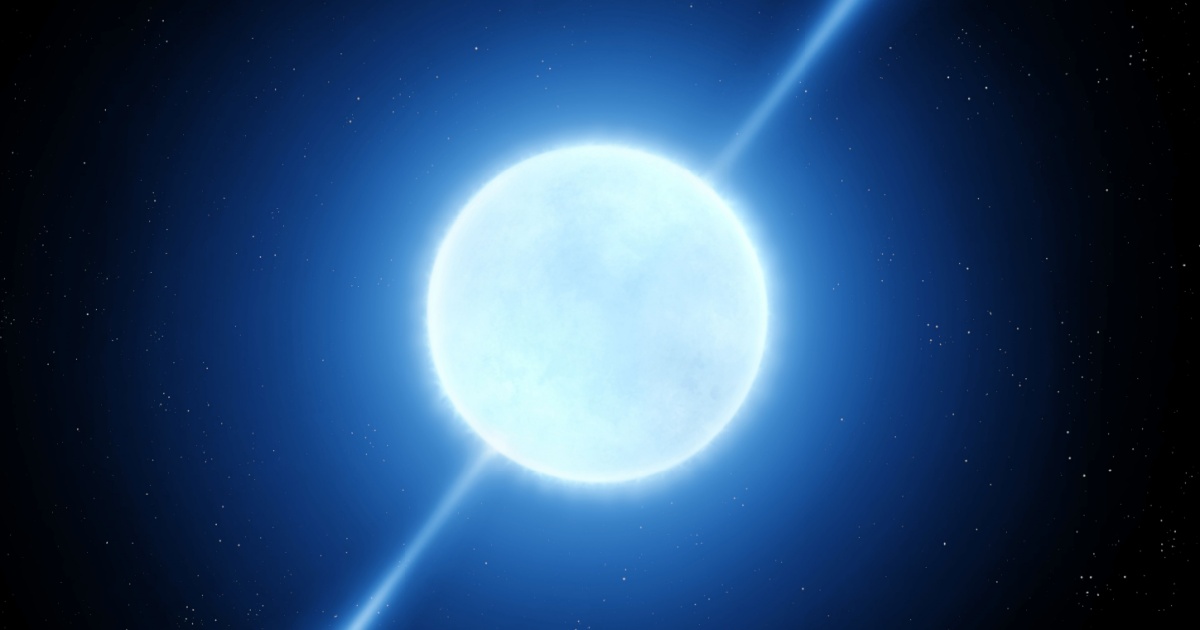
While they haven’t heard anything from aliens quite yet, they did notice what they believe to be signals from a pulsar that they think is located at the center of our galaxy, near the massive black hole. They wrote up their findings in a study, which is published in the Astrophysical Journal. Their hope is that other astronomers can confirm their findings, and then that the pulsar can be used for future tests.
The pulsar that they found is known as a millisecond pulsar because it spins hundreds of times per second. The signal has been measured to repeat every 8.19 milliseconds.

Shutterstock
Perhaps more importantly is the fact that it appears to be located near Sagittarius A, the supermassive blackhole at the center of the Milky Way galaxy.
Sagittarius A is huge. About 4.3 million times as massive as our sun. That amount of mass has a lot of gravity, and it would therefore influence the signals from the pulsar in some important ways. In a statement on the find, co-author Slavko Bogdanov from the Columbia Astrophysics Laboratory, said:
“Any external influence on a pulsar, such as the gravitational pull of a massive object, would introduce anomalies in this steady arrival of pulses, which can be measured and modeled. In addition, when the pulses travel near a very massive object, they may be deflected and experience time delays due to the warping of space-time, as predicted by Einstein’s General Theory of Relativity.”
If their findings are accurate, the tests that could be run on it could help to improve the understanding of General Relativity as a whole.

Shutterstock
Needless to say, the authors and many other astronomers and physicists are excited about the potential.
If you thought that was interesting, you might like to read about a second giant hole has opened up on the sun’s surface. Here’s what it means.