


Kise et al/Royal Society Open Science
When you’re going about your daily life, there’s all sorts to look at – and thanks light (whether artificial or natural) we can do just that.
If you’ve ever been snorkelling, you’ll know that sunlight shines through the water, allowing you to see the corals and the fish, the plants, and everything else that exists near the water’s surface.
But what about if you look deeper, using technology to look further beneath the surface of the ocean than the pressure allows humans to dive?
It’s dark down there, impossible to see anything, right?


Kise et al/Royal Society Open Science
Sure it’s dark, but you might be surprised to know that many of the creatures who exist in the deep ocean do actually need light to survive. How to get this light, when they live so deep that the sun’s rays can’t reach them?
Well, they emit their own, of course. In fact, bioluminescence is not uncommon in creatures that live in the deep ocean, with reactions inside the body of the creature allowing them to glow in incredible rainbow shades.
Of course, the deepest seas are still very much a mystery to us, the darkness, distance and pressure limiting our exploration and understanding of their lives by the ocean floor.
Which means that new discoveries are exciting, and the recent discovery of a new coral species in the ocean near southern Japan was no exception.


Kise et al/Royal Society Open Science
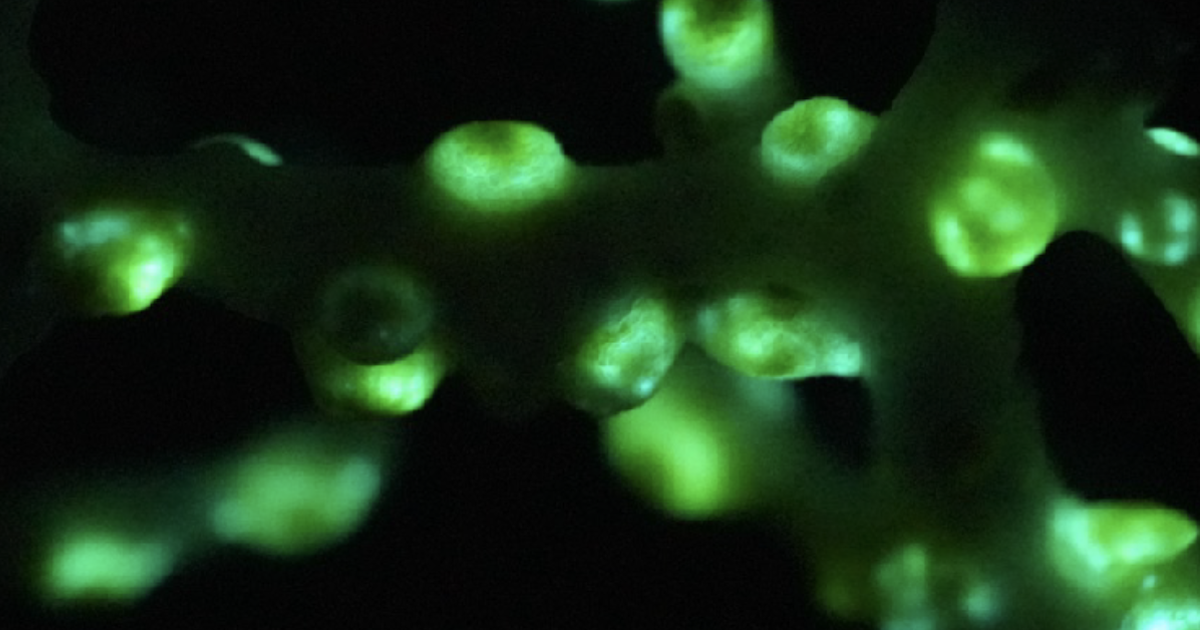
Published in the journal Royal Society Open Science, the discovery of Corallizoanthus aureus is fascinating for several reasons. Firstly, this is the first known bioluminescence in a deep sea cave, telling us more about life in this under-discovered part of our seas.
Secondly, and even more interestingly, the coral doesn’t glow all the time, as you might imagine. In fact, the scientists’ investigations proved that the coral only glows when it is touched, suggesting that it could be a defence mechanism.
Given the coral lights up when touched, the scientists suggest that it may be illuminating the creature about to predate on it, making the predator suddenly visible to other, bigger creatures who might eat it before it eats the coral.
Not a bad way to protect yourself, really.
If you enjoyed that story, check out what happened when a guy gave ChatGPT $100 to make as money as possible, and it turned out exactly how you would expect.