


Shutterstock
If you’ve ever missed a meal, you know what it feels like to be hungry. If you’ve ever tried fasting for a day or more, you may really know that feeling where your brain can do little more than think about food.
Interestingly, for most people, after a day or two of fasting, the hunger actually subsides for the most part and only comes back in short-lived waves as something of a reminder that they should eat, but not a distraction.
This is most likely an adaptation from the fact that throughout most of human history, people went through plenty of times where food was quite scarce. The last thing they needed was to become lethargic and distracted by their hunger when they were out hunting.
The feeling of hunger is largely controlled by a hormone called ghrelin. It is produced in the stomach and signals the brain when it is time to eat. This isn’t just a human thing either. Almost every animal has this hormone in place to help regulate their times of eating and drive them to find food.
But what about snakes that can go months, or even over a year, between meals. Surely they aren’t suffering hunger pangs this entire time, right?

Shutterstock
Well, researchers studied just this thing and published their results in the journal Open Biology. In that study, evolutionary biologist Rui Resende Pinto from the University of Porto, who is the coauthor of the study, discussed what they found when they looked at the genes responsible for producing ghrelin:
“We were getting fragments, just small pieces of the sequence.”
To put it simply, these animals don’t have the genes to produce ghrelin like other animals do. Even more interesting is that it appears that reptiles evolved to lose this gene multiple separate times in different ways throughout history. This is a strong indication that not producing the hormone has some significant evolutionary advantages in the reptiles.
Another thing that they found was different in these animals that can go long periods of time without food was that they didn’t have an enzyme known as MBOAT4 (membrane bound O-acyltransferase domain containing 4). This is an enzyme that is essential for various types of activity. The researchers explain why they think this is:
“[the] loss is a likely consequence of one of the many extreme physiological and behavioral adaptations that reptiles, particularly snakes, have evolved to survive in environments in which prey availability is uncertain and the need for energy budgeting is a constant.”
The explanation makes sense. For most animals, getting food means getting up and finding it. Whether that is hunting down prey or looking for fresh plant (or walking to the refrigerator), your brain needs to know it is hungry and then have the ability to move in order to get food.
For reptiles, and especially snakes, however, that is not how they get their food. In fact, they do it in almost the exact opposite way. They find a place that seems safe to them and then they sit, virtually motionless, until food comes to them.

Shutterstock
They can sit for days, weeks, or months with virtually no motion until prey comes by, at which point they strike.
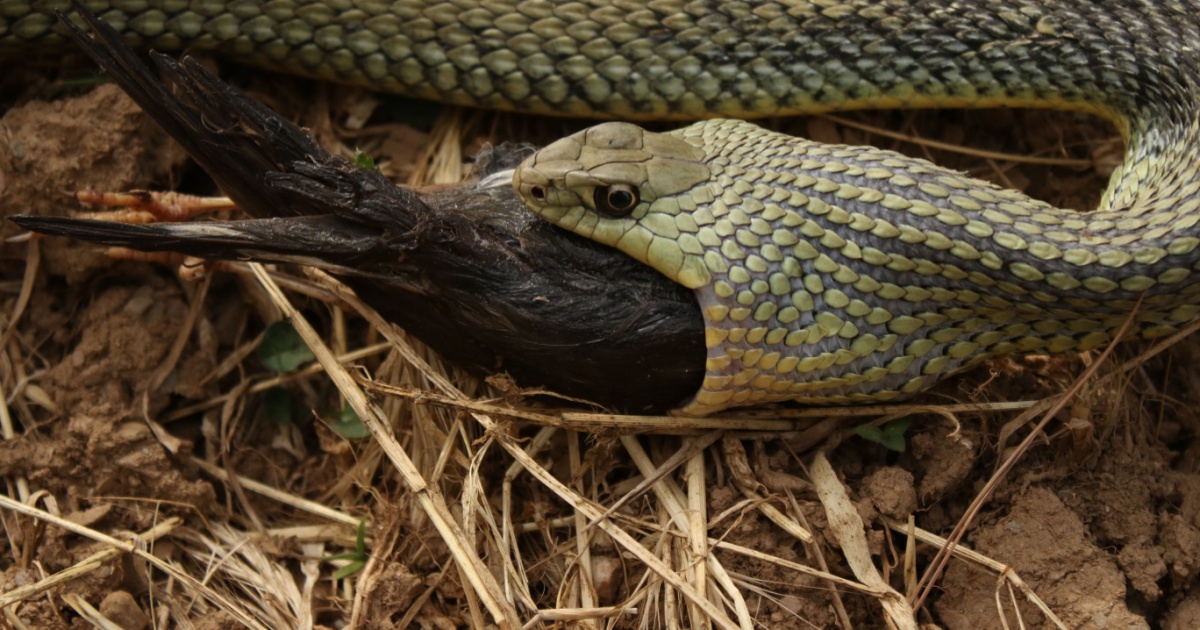
What is also important to note about these animals is that their limits on how much food they can eat are almost purely physical. You might see a snake eat an animal that you would think is impossible. Some snakes eat animals that are nearly their same size. To put it simply, if the snake can get it into its mouth, it will eat it.
This is in contrast to humans and other animals who, when everything is working properly, will eat until they are full (and then maybe a little extra snack), but then they will have no desire to keep eating.
It is easy to see how a snake would benefit from eating as much food as is physically possible when it is available since they may have to go a long time without another meal.
Thought that was fascinating? Here’s another story you might like: Why You’ll Never See A Great White Shark In An Aquarium