


Shutterstock
Throughout human history, there have been many times when humans discovered major landmasses that were previously unknown.
Sometimes it would be a discovery that marked the very first time human feet walked on a piece of land, and other times it was simply a discovery where a major group of people found land that they didn’t know existed, but was already inhabited.
Today, we can be pretty confident that there are no more undiscovered landmasses of any significant size on Earth. This is thanks in large part to the use of satellites, which can see virtually every inch of the planet.
It wasn’t all that long a go that the last landmass was found, and less than a century since it has been mapped.
It was in 1913 when the Icebreaker ships Taymyr and Vaygach from Russia were exploring the extreme Northern regions of the ocean. In this region, new ice forms and moves regularly, so it is common to have to change course.
That is exactly what happened on September 1st, 1913. They ran into a solid ice field that was located on the east coast of Poluostrov Taymyr. They altered their course to head north to try to navigate around it.

Shutterstock
Early the next morning, they spotted a small island that was previously unknown. They stopped briefly and named it Ostrov Tsesarevicha Alekseya before heading back out to sea and continuing on their journey north.
That night, Dr. L.M. Starokadomsky was on the bridge when he saw something unexpected. He wrote of the event:
“Dawn was breaking, but the horizon was still hidden in fog. And suddenly, ahead and a little to starboard of our course, I began to make out the vague outline of a high coastline. Or could I be mistaken? Was I the victim of an optical illusion? Without saying a word to Gyune for the moment (the warrant officer had noticed nothing) I strained my eyes and peered intently into the darkness. No, there could be no mistake. I could definitely see land – the outline of the abrupt, high landmass had not changed, and was now very distinct. Snow patches could be seen on the mountains. Ahead of me, without a shadow of doubt, lay a high mountainous coast.”
After notifying the rest of the crew, they changed course and went toward the previously unknown landmass. Prior to this, there had been no records of any humans in history ever having seen, much less walked on, this island.
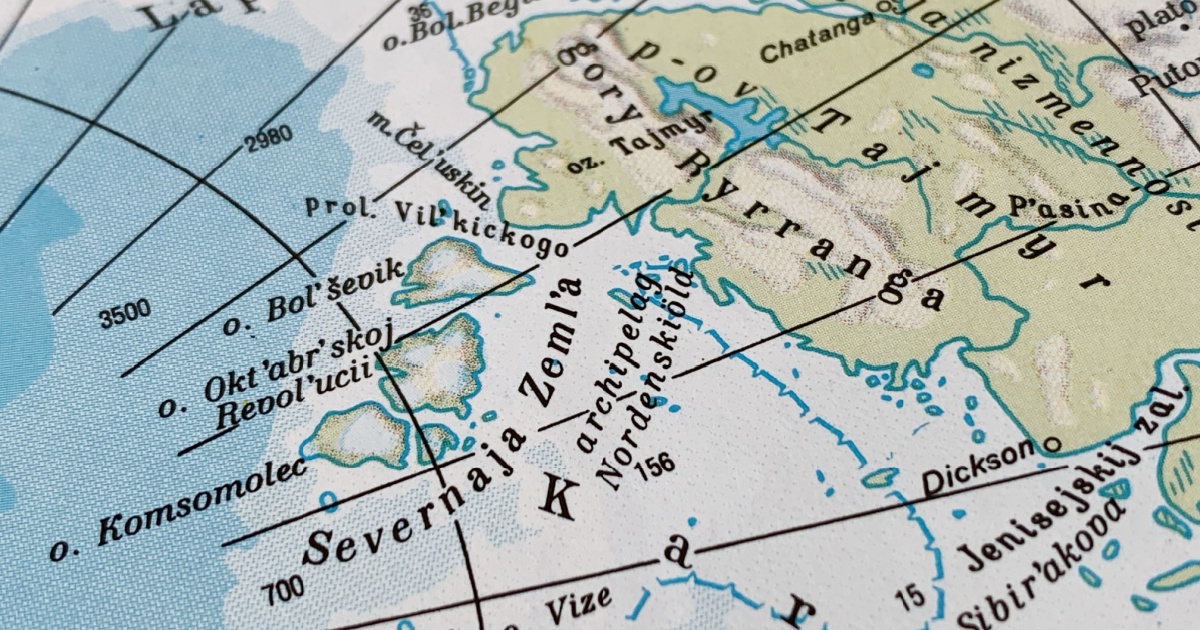
They took some time to explore the area and found that there are five islands making up the archipelago, which is named the archipelago of Severnaya Zemlya. The five islands are named: October Revolution Island, Bolshevik Island, Komsomolets Island, Schmidt Island, and Pioneer Island.
It wasn’t until 1930 that these islands were fully mapped. This was done by an expedition of Georgy Ushakov and Nikolay Urvantsev.
You can see part of this amazing land in a video below, recorded from a helicopter:

NASA explains that while they were the last landmasses to be discovered, they are not small:
“The Severnaya Zemlya archipelago in the Russian high Arctic spans 37,000 square kilometers [14,286 square miles] – about the same area as the U.S. state of Indiana. You won’t find any trees growing here. This is Arctic tundra, and cold, dry conditions prevail throughout the year. The average daily temperature in August, when this image was acquired, is 0 degrees C (32°F). Such conditions are quite favorable for year-round ice, which covers about half of the archipelago.”
Due to the freezing temperatures and rough terrain, this land has remained uninhabited other than by some birds and visiting polar bears.
If you found that story interesting, learn more about why people often wake up around 3 AM and keep doing it for life.