


Shutterstock
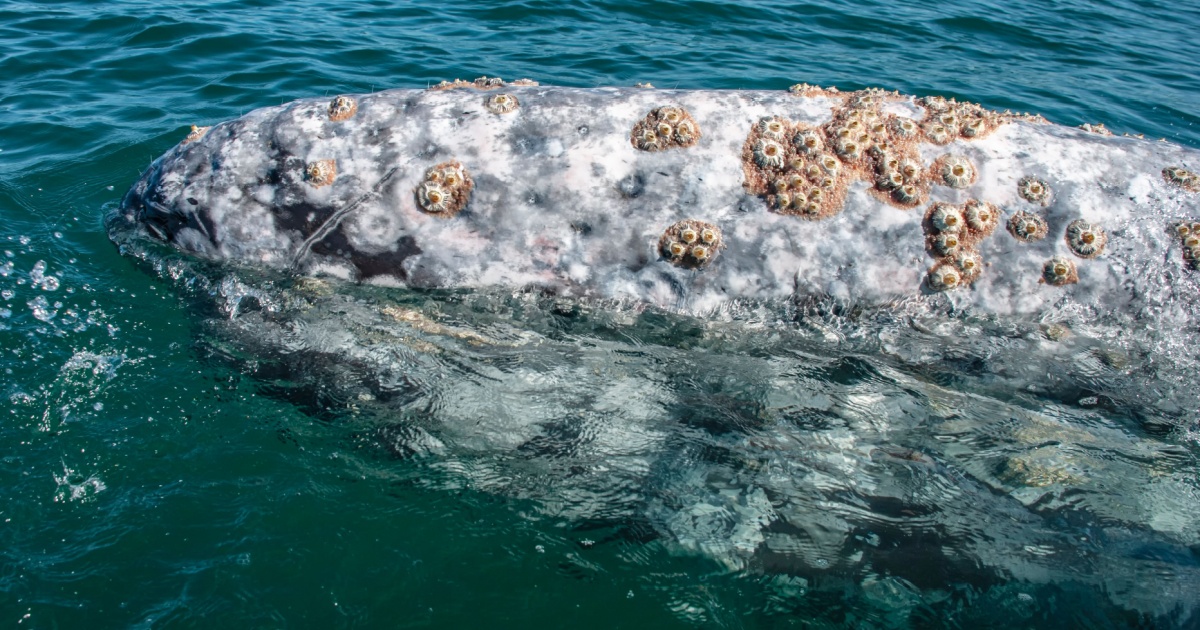
Whales are amazing creatures, swimming throughout the Earth’s oceans often traveling thousands of miles to follow food, mate, and seemingly just have fun. Almost anywhere you find whales, however, you’re also going to find barnacles.
Barnacles are a species of crustation, but unlike shrimp, lobster, and crabs, barnacles don’t move around on their own. Instead, they attach to one thing and if all goes right, they will remain in place throughout their life.
There are over 2000 different types of barnacle out there. Some of them like to attach to rocks, others attach to turtles, and others target whales to be their host. Many of the barnacles are not that picky and will attach to whichever of these things they come across first, but other species hitch a ride almost exclusively on one type of animal.
Regardless of the type of barnacle, their way of living has proven to be extremely successful as they have been around for millions of years. The ones that hitch a ride on whales, turtles, and other animals seem to have it especially good because their host animal brings them along to find food everywhere they go.
Professor Geoffrey Boxshall is an expert on small crustaceans like barnacles at the Natural History Museum London, and Fellow of the Royal Society. He discussed why barnacles so often love hitching rides on whales and other similar animals. The first reason he gave is related to how whales live their life:
“Cruising around the well-lit and productive surface waters of the oceans where small plankton, the food of the barnacles, is abundant.”
Then, he went on to add that it is, at least in part, due to the sheer size of whales:
“The large size of the whales provides plenty of surface area for attachment.”

Shutterstock
Perhaps most importantly, it is the fact that whales travel in groups and hang out together for most of their lives:
“Whales aggregate for mating and feeding, and they often travel in large groups. This provides plenty of opportunity for the larvae of the barnacles to find and attach to the whales. Otherwise, it is a big ocean for the barnacle larvae, just 1 to 2 millimeters long, and they need to find their ‘host’ before their larval food supply is used up.”
Whatever the case, barnacles have been attaching themselves to the skin of whales, turtles, and other large marine animals for as far back as researchers have looked.
While it may seem like these tiny crustations are parasites on the whales, that is not technically true. The barnacles don’t actually cause any harm or feed off of the whales, so they cannot be classified as a parasite. The benefits to the barnacles are quite obvious, but at least as far as we know, there are no benefits to the whales or other animals, so they can’t exactly be seen to be symbiotic either.
Instead, these barnacles seem to just be freeloaders who have found a way to benefit from their host animals without causing any harm for the most part.
Humans, however, often see the barnacles as bad and sometimes try to rip the barnacles off of the host animal when they get close enough. In some situations, such as when the barnacle attaches near an eye of a whale or at the joint of a flipper on a turtle, this can be good (if it is done carefully).

Shutterstock
Other times, however, attempting to rip the barnacle off can actually hurt the whale or turtle since the barnacle is stuck on so securely. With this in mind, it is generally best not to try to remove them unless you have been trained on how to do it safely. Fortunately, very few people ever get close enough to whales or even sea turtles to be given the opportunity.
Plus, if the barnacles start causing irritation or are in an inconvenient location, the whales can often get them off by scraping against an object or jumping out of the water and landing on the area where they are attached.
The bottom line is, while barnacles may seem gross and terribly irritating, they are really just a piece of nature that has found a way to to thrive in the big ocean, and we shouldn’t begrudge them that ability.
If you found that story interesting, learn more about why people often wake up around 3 AM and keep doing it for life.