


Pexels/Reddit
Getting your first job can be a truly exciting prospect.
You’re an adult now and about to have physical and financial independence to start off your adult life.
But no one said that was easy – and sometimes, we realize that our hopes for work are very different from reality.
This is exactly what happened to the young employee in this story.
Instead of a dream job, it was damaging their mental health, and there was no easy way out.
Read on to find out what happened.
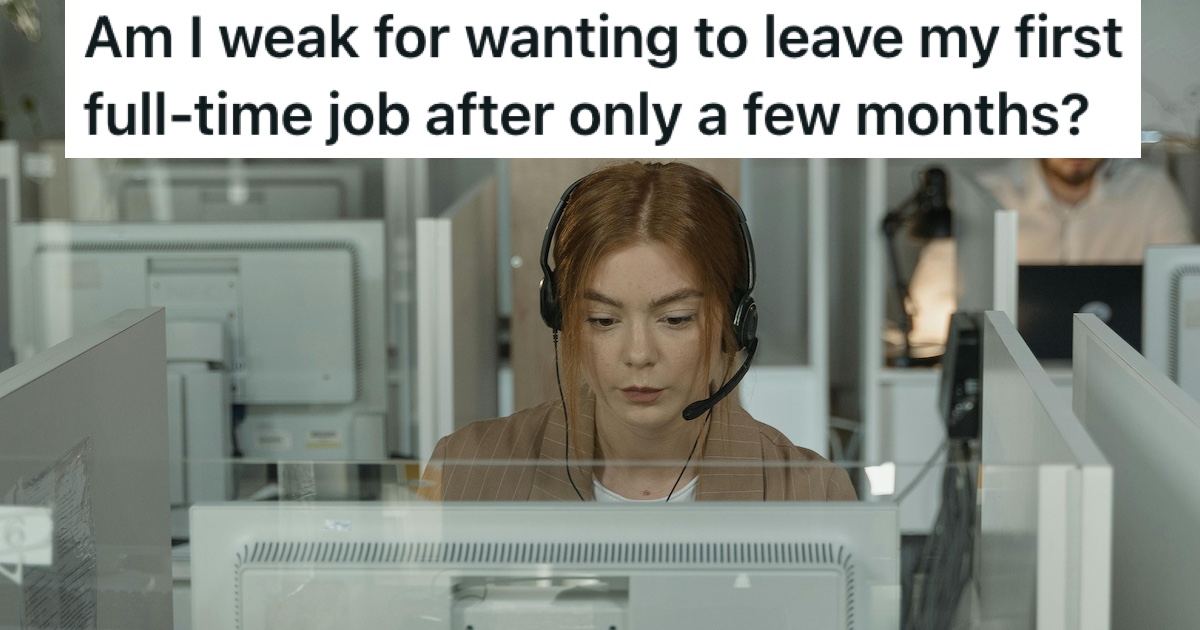
Am I weak for wanting to leave my first full-time job after only a few months?
I’m 22 and currently working my real full‑time job – it’s my first “adult” job after finishing my training.
I was so hopeful when I started, and I truly believed this could be the start of my career.
Instead, I’ve been mentally falling apart since the beginning.
Let’s see what this employee is struggling with at this job.
I transferred internally into a call‑center‑style role in October 2025 at a large company here in Switzerland (which I won’t name, for obvious reasons).
From my first days, something felt wrong — a deep gut feeling that this wasn’t for me.
I ignored it. I told myself I was just anxious, that I needed time, that I should be grateful.
But she couldn’t ignore it.
By my second week, I was already breaking down.
I felt constantly anxious, overstimulated, exhausted.
I ended up calling in sick because I felt mentally unable to function.
I’ve never felt that overwhelmed by a job before.
Uh-oh. Read on to find out why this call centre is so unpleasant.
This role constantly drains me: nonstop calls with angry clients, pressure, zero breathing room and just overall not fitting with the team, despite most of them being nice and helpful.
I feel like my nervous system is permanently in fight‑or‑flight mode.
I come home empty. No energy. No joy. Just dread for the next day.
She has considered several options.
I’ve struggled with mental health before, but this job made everything worse.
I even considered going to a doctor to get a medical certificate for burnout because I genuinely don’t know how much longer I can do this.
But here’s the thing: I never went to my managers to talk about it — not because they’re rude or anything (in fact, they constantly say “you can always talk to us”), but because I don’t trust that they’d actually understand.
It’s clear that the employee is struggling here.
I don’t trust that anything they could say would change the core problem: this job simply isn’t for me.
It’s not just about “adjusting” or “communicating better.” I know that if I had gone to them, they’d probably ask “What can we do to make you feel more comfortable here?”
But how do I answer that when the real truth is. I never felt right there, and I want to leave.
I kept quiet because I wanted to protect myself. I wasn’t ready to be vulnerable in front of people I barely know. And frankly, I’m not at a point in my career where I can afford to be fully honest with managers when I don’t know if it’ll come back to bite me.
And this employee isn’t alone in their mental struggles.
The worst part? I wasn’t the only one.
A colleague who started at the same time as me (also in October) already left the company in late December. He was gone before his probation period even ended.
That alone told me a lot.
But there are good reasons why this employee can’t simply walk away.
Since November, I’ve been quietly applying for other jobs. But I’m still stuck — because in Switzerland, if you want to receive unemployment benefits, you need to stay with an employer for at least one full year.
And even if I resign, I have to wait until the end of the following month to actually leave.
What makes it worse is the system. In Switzerland, you can’t just quit and leave like in the US.
To qualify for unemployment benefits, you must work at least one year with the same employer, and there are fixed notice periods. That means even if I resign in February, I’m still stuck until the end of March.
And it has left the employee feeling awful.
I’m mentally struggling. And yet, I feel like I have to smile and pretend I’m fine just to survive this system.
I wanted this job to work out so badly. I was excited. I had dreams. Now I just want peace.
I feel ashamed for wanting to quit so early. Like I failed at being an adult.
But I also know that staying is slowly breaking me.
It’s really sad to hear the turmoil that the employee is struggling through in their first full-time job role.
It’s clear that the atmosphere and the specific challenges of the job are not for them – they would test the mental health of anyone, and it doesn’t make the employee weak or a failure at all.
In fact, this experience might just help them to narrow down what kind of job roles are for them going forward.
Let’s see what the Reddit community made of this.
This person gave them some pointers.


While others explained that the employee isn’t the problem, the call center is.

Meanwhile, this Redditor had faced a similar situation.

This employee needs to find a new job.
Thought that was satisfying? Check out what this employee did when their manager refused to pay for their time while they were traveling for business.