


Shutterstock
When studying an object that has been traveling through the universe for billions of years and has never before come anywhere near our solar system, you have to expect some surprises.
Asteroid 3I/ATLAS entered our solar system, and as soon as it was spotted, it became the target for as much analysis as possible since it is only the third object from interstellar space that we have ever identified.

Shutterstock
On October 29th, 2025, it reached its Perihelion, which is the point in its path where it is the closest to the sun. Even at this point, it was still about 36% further away from the sun than the Earth is.
This object hasn’t been closer to a star in millions, or possibly billions, of years, though, so it is quite a rare event.
Data was gathered using a variety of tools, including NASA’s Spectro-Photometer for the History of the Universe, Epoch of Reionization, and Ices Explorer (SPHEREx).
Since then, researchers have been busy analyzing that data, and now a study has been published about some of the findings on the ArXiv platform. This study has not yet been peer reviewed.
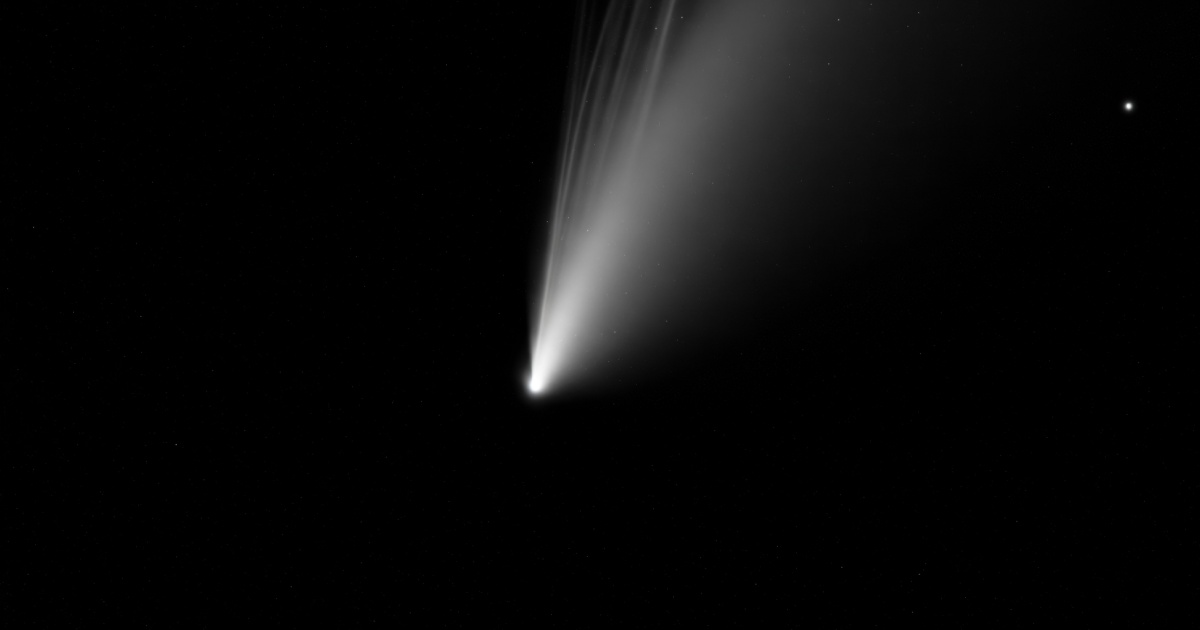
As the comet came closer to the sun, its material began sublimating, creating a tail. Using SPHEREx’s instruments, which are able to capture 102 colors of the infrared spectrum, researchers can monitor the shape and other details of the ice.
This ice was made of various molecules, including carbon dioxide, nitrides, water, carbon monoxide, and more.
The study found that the distribution of the hydrocarbons from the asteroid was not as circular as that of other molecules, creating a flattened shape.
The dust from the comet formed an ‘anti-tail,’ which is an unusual event where a comet has an extra tail created by the release of heavier particles.

Shutterstock
Additional research is ongoing and likely will be for years to come. In addition, while the comet is now on its way out of the solar system, the SPHEREx will be able to capture more data as it leaves, as is explained by the study authors:
“The spectrophotometric measurements reported here are from a preliminary analysis. A more full-up treatment will be produced before 3I/ATLAS passes through SPHEREx’s planned survey pattern again in April 2026.”
As time goes on, we will continue to learn more about this incredible comet and the universe.
If you thought that was interesting, you might like to read about a second giant hole has opened up on the sun’s surface. Here’s what it means.