



Shutterstock
There are few pains worse than that of a serious toothache. The throbbing, stabbing pain can be so debilitating that people have been known to grab the sore tooth and rip it out themselves just to find relief.
Today, we know that toothaches are caused by infections, inflammation, and other issues, often stemming from a cavity, injury, or other issues.
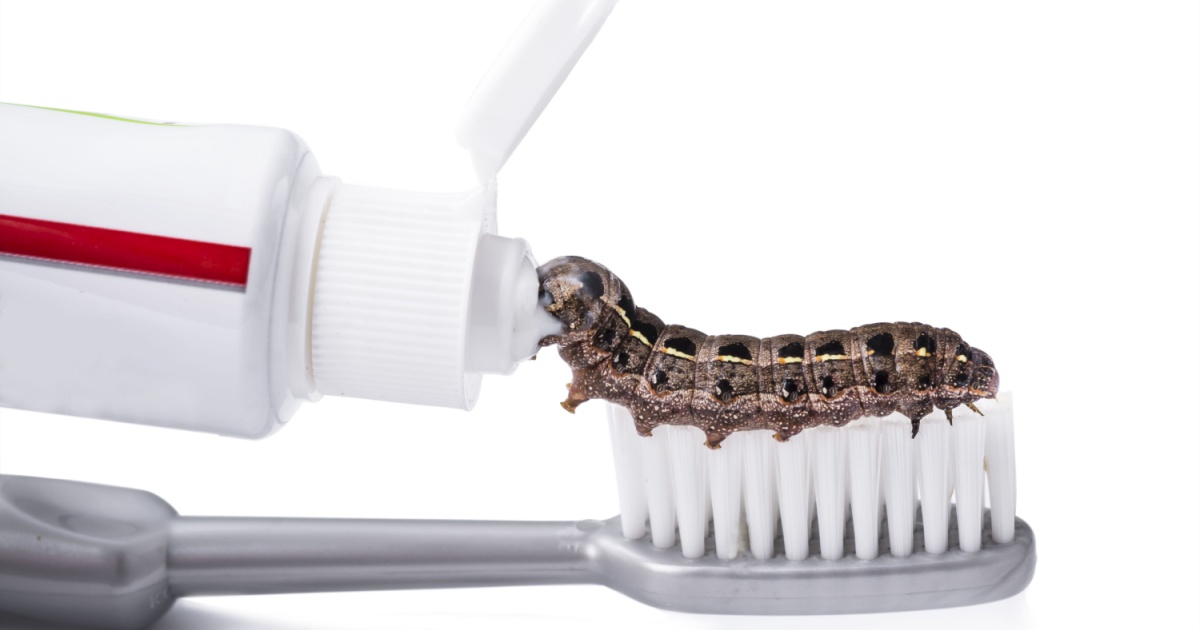
Throughout much of human history, however, it was widely believed that tooth pain came from tooth worms. Tiny worms that would live in or around your teeth.
The idea took different shapes in different cultures, but it has been documented in many different places, illustrating just how widespread it really is.

Shutterstock
One example of this goes back to Mesopotamia, according to the British Museum.
Cuneiform tablets have information about the tultu, which is a worm that was sent to Earth by the gods in order to feed on blood and food scraps in the mouth. One such tablet was translated to say:
“Indeed, [the worm] is the one that became hostile! Via the door of the flesh! Via the bar of the bone! Whom shall I send to the first born-son of the mountains-Marduk, that the worm be smashed! May the worm get out through the doorpost socket like a mongoose!”
Another Cuneiform text on a Babylonian tablet says:
“Place me and let me dwell between tooth and gum so I can suck the tooth’s blood and mince up the gum!”
In England, it was once thought that the tooth worms resembled small eels. German history shows that they described them as red, blue, and gray zanewurms.
Some cultures said that these worms would die when the tooth was cracked, and they were exposed to air. This could actually be the source of some of the claims, since when a tooth is broken open, the pulp inside could resemble a dead worm.
While today we know that there aren’t actual worms in our teeth and gums, the fact that this theory was found in locations around the world is incredible.
Shutterstock
Of course, while no worms are in or on our teeth, the real source of tooth pain is often tiny bacteria or other living things which, when analyzed under a microscope, could appear like small worms.
Maybe our ancient ancestors were on to something.
If you found that story interesting, learn more about why people often wake up around 3 AM and keep doing it for life.