


If you take a look around your home, whether on your crockery or your wallpaper, your ornaments or your favourite shirt, you’ll likely find geometry galore.
That’s because these patterns are particularly pleasing to us, given their orderly structure and, in many cases, beauty.
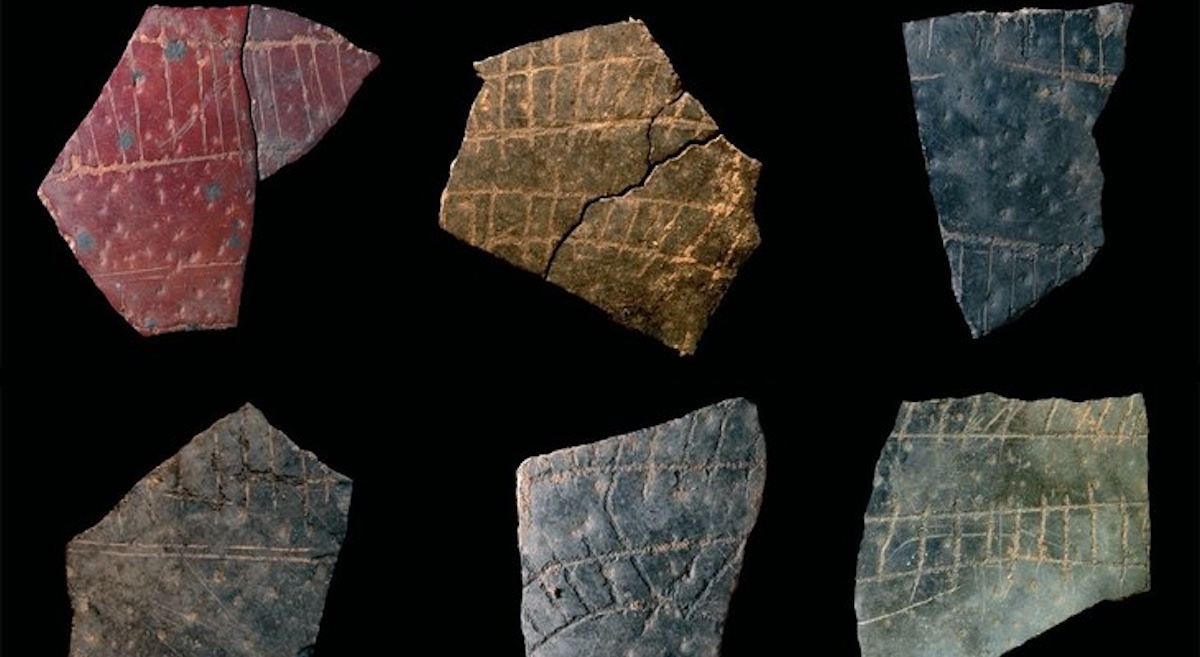
But this is nothing new, and humans have been enjoying looking at – and making – geometric patterns for over 60,000 years, according to a new study published in the journal PLOS One.
Where they found the early geometric patterns is quite unusual though: they were actually engraved onto ostrich eggshells.


Università di Bologna
The eggshells, which were recovered from archaeological sites in South Africa and Namibia, were probably used by their owners as containers for water, over 60,000 years ago.
And that tells us a lot about the way that the Homo sapiens who engraved them thought.
Not only were they decorating their receptacles, Professor Silvia Ferrara explains in a statement, they were doing so following clear, geometric rules:
“These signs reveal a surprisingly structured, geometric way of thinking. We are talking about people who did not simply draw lines, but organised them according to recurring principles – parallelisms, grids, rotations and systematic repetitions: a visual grammar in embryo.”


Pexels
This is particularly impressive, and tells a clear story about Homo sapiens‘ cognitive abilities, given the skillset and logical thinking required to engrave the angles and parallelism of the lines, as Ferrara continued:
“These engravings are organised and consistent, and show mastery of geometric relationships. There is not only a process of repeating signs: there is real visuo-spatial planning, as if the authors already had an overall image of the figure in mind before engraving it.”
The Homo sapien engravers were able to replicate and recreate not only parallel lines but specific angles, and continuous patterns. It’s something that some modern day humans would struggle to visualise, which tells us a lot about those who came before us.
Their cognition and understanding of structure, rules, and abstract thought was more impressive than we might have thought.
If you thought that was interesting, you might like to read a story that reveals Earth’s priciest precious metal isn’t gold or platinum and costs over $10,000 an ounce!