


Shutterstock/Reddit
Imagine working at a grocery store when the power goes out in the middle of a very hot day. Would you follow safety procedures and throw away any perishable inventory, or would you keep it so the store didn’t lose inventory?
In this story, one meat department employee is in this situation, and they decide to follow their supervisor’s orders, only, it turns out, the supervisor didn’t really mean what he said.
Let’s see how the story plays out.
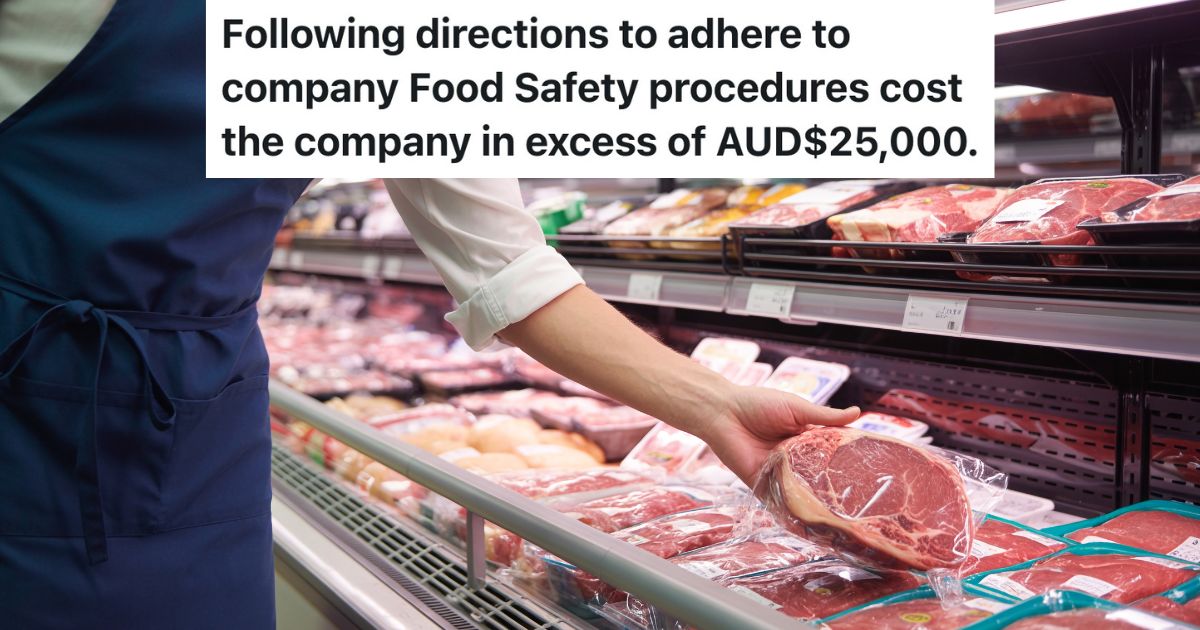
Following directions to adhere to company Food Safety procedures cost the company in excess of AUD$25,000.
Several years ago, I was working as the manager of the meat department in a large Australian supermarket chain.
I’d been pulled up for minor issues relating to food safety in the past (mainly relating to temperature checks, and cabinet cleaning).
During the discussions about these issues, I was told, as well as recorded in writing, that the “food safety guidelines are a legal document, and are not up for negotiation or interpretation, and must be adhered to to the letter” (remember that quote)
Uh-oh!
Fast forward to a few days before Christmas. My store was one of the busiest in the region, so the meat case and cool rooms were packed to the absolute max with stock, hams, roasts, turkeys, the whole works.
It was the same store wide, absolutely maxed out.
Christmas in Australia is unlike most other places; it gets hot.. damn hot… On this particular day, the temperature outside was pushing 45°c (approx 110°F).
Aircon and fridges were all working hard to keep everything cool, when suddenly at about 3pm, we have a store-wide blackout.
This is really bad!
Usually, we have a backup generator which would kick in and keep the cool rooms running, so that worst case, stock could be emptied out of the cabinets and into the rooms to keep it food safe.
Well, for some reason, the generator didn’t kick in, and the store was completely without power and running on emergency lighting only.
We evacuated the store, and were contacting technicians, etc to get things running again.
I checked the food safety guidelines book and the policy in such a situation was to monitor the temperature of stock every 15 minutes, and if it reaches over 4°c and stays there for more than 2 hours, all affected stock must be discarded.
OP was prepared to do what needed to be done.
Being such a hot day, the temperature had already breached the 4° upper limit when I did the first check, meaning the countdown was on to get things running again.
I documented absolutely every step of the way, following the guidelines to the letter.
At 4.45pm, with 15 minutes to go until the deadline, I went to the office and got a handheld scanner in preparation for what was to come, and was spotted by the store manager who asked what I was doing.
I told him that I was getting it to begin dumping stock.
If only the truck had arrived sooner!
We argued back and forth with him saying that the stock would be fine and that a refrigerated truck was on the way to move everything into.
It ended in me saying “the guidelines are a legal document, by ordering me to go against what they say, you’re instructing me to break the law, which I am respectfully refusing”
At 5pm I began scanning off and dumping stock from my case.
I’d already almost filled an entire dumpster with stock when the refrigerated truck turned up.
Now, it’s really getting heated!
The manager once again instructed me and the fellow department managers to take our now-unsafe stock and move it into the truck.
Everyone hesitated, but I flat-out refused and continued dumping my stock.
He eventually revoked my access to the handheld scanner in order to stop me.
So I called the area manager (his boss) and explained the situation and what he had instructed.
It turns out there was some “wiggle room.”
Area manager said although it was never public, there was actually some built-in wiggle room between the company policy, and the legislated state code, and that although it breaches the company policy, the state food safety code hadn’t yet been breached., but was furious that the store manager had instructed me to intentionally breach the company policy.
I told the area manager that I had been instructed and documented to “follow the food safety guidelines to the absolute letter”, and that the policy was “non-negotiable and not up for interpretation”.
He agreed that I had done the correct thing by dumping the stock, and also agreed that I was within my rights to refuse the orders of the store manager thinking they were illegal.
Here’s how it worked out.
All in all, I dumped about $25,000 of stock, and my team got a ton of overtime to bring the case and stock levels back up to presentable standard for Christmas.
The manager got a very severe reprimand, and was fired for an unrelated issue not long after.
It’s better to be safe than sorry when it comes to food safety. It would be awful to sell unsafe meat to customers, especially right before Christmas!
Let’s see how Reddit responded to this story.
One person believes the manager was partly fired due to this issue.


I completely agree with this comment.


It really doesn’t seem malicious.


Here’s another story about a grocery store that lost power.


It’s better to play it safe than sell spoiled food.
If you liked that post, check out this post about a rude customer who got exactly what they wanted in their pizza.