


NASA
Back in September 2025, NASA launched a groundbreaking project that will allow scientists to study the heliosphere in detail for the first time.
This giant bubble in our solar system around the Sun and planets, caused by the solar wind that the Sun constantly emits, is worth studying for many reasons.
For one, it’s important to map and understand its boundaries as well as simply how it works, since the heliosphere protects all the planets in our Solar system from cosmic rays and interstellar radiation.
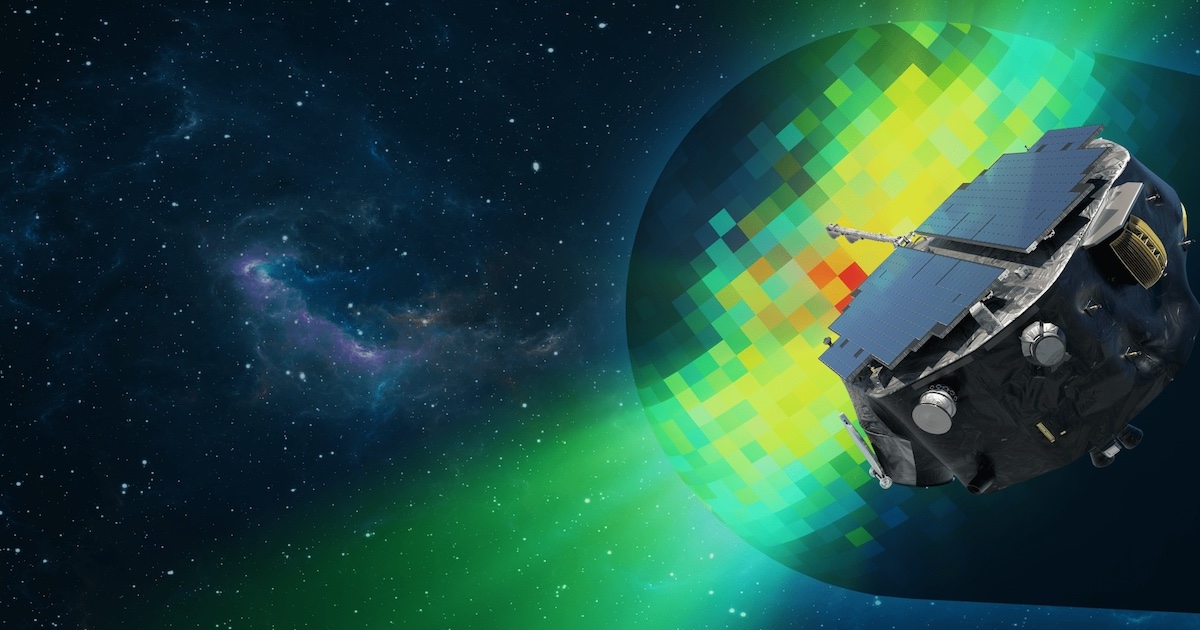
The good news? NASA’s IMAP (Interstellar Mapping and Acceleration Probe) mission not only launched successfully, but has recently proven that it is in full working order from its position in space.


NASA/Goddard Space Flight Center/Conceptual Image Lab/Walt Feimer
According to a December 2025 NASA statement, all ten of the probe’s instruments have proven their full functionality, with their first observations sent back to Earth, as NASA’s Brad Williams explained:
“We are extremely pleased with the initial in-flight performance of the IMAP mission. All instruments have successfully powered on and our commissioning remains on track. We have already collected useful data including exercising our near-real-time space weather data stream. This successful milestone is quickly setting the stage for the start of our primary science operations.”
In order to map the heliosphere, IMAP uses various tools to study uncharged particles known as energetic neutral atoms (ENAs), and even early on its journey to its eventual observational point, a million miles away from Earth known as Lagrange point 1 (L1), the probe is already studying ENAs.
Early in its journey, the ENAs encountered by the probe were those coming from the Earth; as of January 10th 2026, NASA have confirmed that IMAP reached L1, from where it will be able to study those ENAs at the boundary of the heliosphere.


NASA
But IMAP isn’t just about mapping and understanding the heliosphere.
In fact, from its vantage point, the probe is able to study solar wind, providing warnings to astronauts and other spacecraft about potentially dangerous levels of radiation and solar storms as they happen.
The good news? The tools that provide this functionality are working well too, meaning that we will have much better understanding of the space weather heading our way in future.
From one million miles away, IMAP will be invaluable to deepening our understanding of what’s going on out there.
If you thought that was interesting, you might like to read about a second giant hole has opened up on the sun’s surface. Here’s what it means.