


Shutterstock
There are many things that set humans apart from other animals. One of them is our ability to think abstractly.
While there is no doubt that animals can think in some surprisingly complex ways, they don’t show the ability to really imagine things like a person.
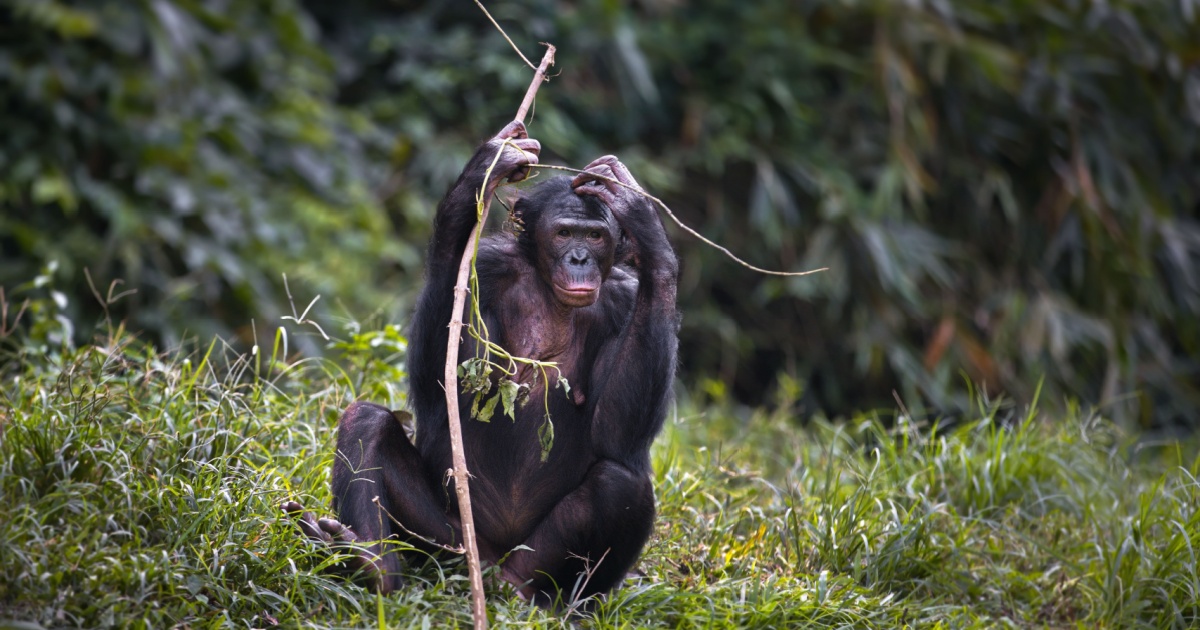
Researchers from Johns Hopkins University, however, did a study on the way bonobos think and whether they can use their imagination like humans. The study was published in the journal Science.
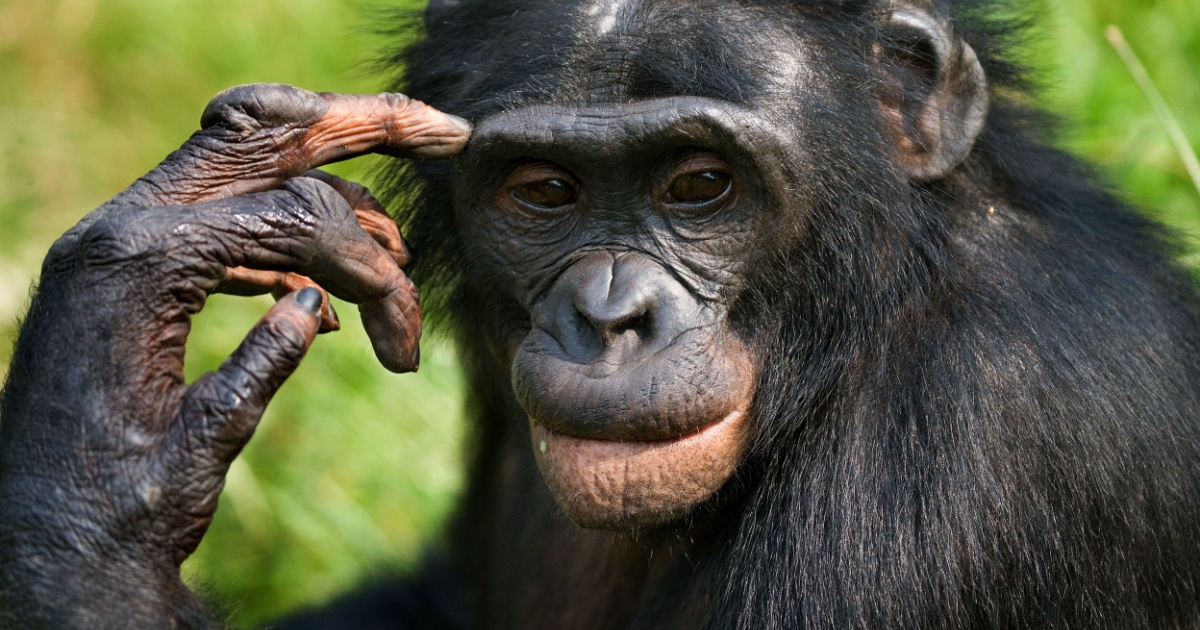
Part of that study included trying to show one particular bonobo how to have a tea party, which is one of the most common examples of pretend play in humans. Dr. Amalia P. M. Bastos is the author of the study, and she explained:
“The tea party pretend scenario is the sort of context that was first used to show pretence in children, when this phenomenon was first studied by psychologists in the late 1900’s. It seemed well-suited to Kanzi, too, as he has observed and interacted with cup-like and jug-like options throughout his life as a very enculturated ape, so the original methods used to study children only needed minor modifications to be applied to Kanzi.”
The experiments checked to see if the bonobo would engage with pretend juice by doing things like pouring it in a cup and pretending to drink it. They did the same thing with pretend grapes.
In the end, they found that he could tell the difference between real and imagined things, but would certainly interact with the imaginary.
The authors believe that this is an indication that human ancestors likely developed the ability to pretend around 6-9 million years ago, which would have been when they expect that they were on a similar level to the bonobo.
Sadly, Kanzi the bonobo passed away in 2025. He was 44 years old. Bonobos generally live to 20-40 in the wild, and 40 is about average in captivity. Bastos commented on Kanzi and the future of this line of study, saying:
“If Kanzi were still with us, we would have loved to attempt some studies where he might engage in pretence himself, rather than observing the researcher perform pretend actions alone.
Given that this is no longer possible, our next steps may now focus on modifying our study methodologies to try and investigate this sort of phenomenon and ability in less enculturated apes. We are beginning to think of some ideas on how we might be able to do so in the future, for example through eye-tracking technology.”
Shutterstock
Continuing to research how animals can use basic concepts of imagination can help humans to learn more about our past and possibly the future of animal development.
Thought that was fascinating? Here’s another story you might like: Why You’ll Never See A Great White Shark In An Aquarium