


Shutterstock
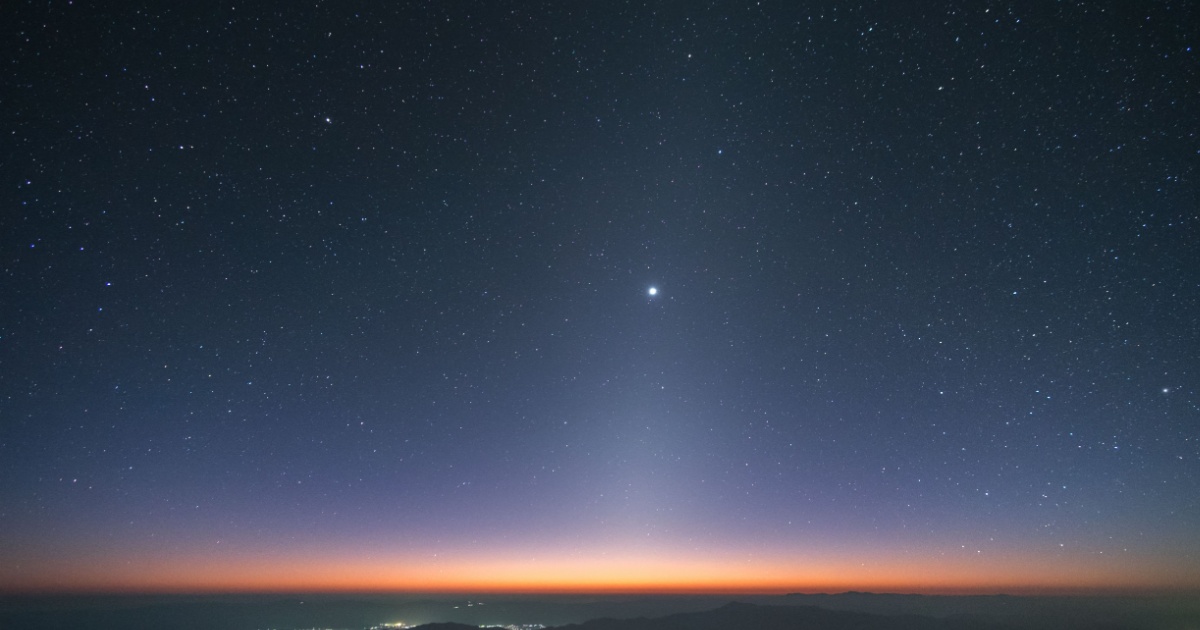
Each year, around the spring equinox, there is an astronomical event that causes a mysterious glow to appear in the western sky. It has been noticed for many centuries, and it wasn’t well understood until very recently.
The glow, known as the zodiacal light, appears in the same belt of constellations as the zodiac signs that give it the name.
On a clear night between 90 minutes and two hours after sunset, looking to the west, you can see a light that is vertical from the horizon, often appearing to be a pyramid shape.
So, what is the zodiacal light?
An explanation of this light was first proposed by astronomer Giovanni Domenico Cassini in 1683, when he thought he had discovered the light himself.

Shutterstock
While many people had seen and even written about it throughout much of history, he did write a paper on it that gave the first proper explanation that turned out to be pretty close to being right.
In the paper, he proposed that the light was a reflection of sunlight off particles that are circling the sun. Since then, astronomers tried to figure out what particles they were and where, but it wasn’t until 2010 that it was said that the dust that caused the reflection came from comets.
Then, in 2020, this idea was further clarified to say that much of the dust actually came from Mars. John Leif Jorgensen is a professor at the Technical University of Denmark, and while tracking the path of the NASA Juno spacecraft, he noticed an issue. He said:
We thought, ‘Something is really wrong. The images looked like someone was shaking a dusty tablecloth out their window.”
There was way more dust than would be expected at this point in space, and the only object that was there that could cause the dust was Mars.
Even today, however, it is not known how or why this much dust escaped from the Martian gravity to form a circle along its orbit.

Shutterstock
What we do know, however, is that the zodiacal light is an incredible event that people throughout the world have enjoyed.
It is seen in the western sky just after dusk by most people reading this, though those in the southern hemisphere would see it just before sunrise since they are looking from the other direction.
For those lucky enough (astronomically speaking) to live at or near the equator, there is no need to wait for the equinox to see the light. They can view it all year long.
If you enjoyed this story, check out this study that suggests the climate crisis is negatively impacting young people’s health.