



Shutterstock
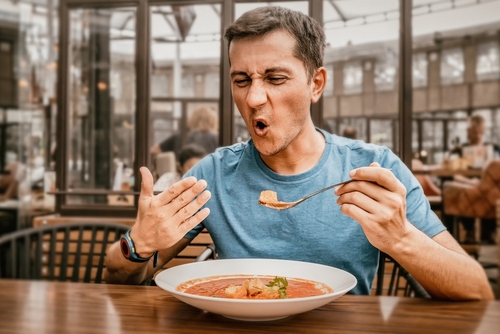
If you love spicy foods but have other members of your family or friend group who don’t really like them, you have undoubtedly had to dial down your order so that you can accommodate the palates of other people. When purchasing food for a group, it seems that it is always necessary to choose something that is very mild so that nobody is left out.
Of course, this means that the spice lovers in the group are left to eat food that isn’t up to their standards.
Well, according to a study published in the Journal of Agricultural and Food Chemistry, a solution to this problem may be coming soon.
The researchers who worked on the study claim to have found a new ‘anti-spice’ that naturally lowers the spiciness of most types of foods. So, if you order a Thai dish that is blazing hot for you, those in the group who don’t like it so hot can just sprinkle this new anti-spice on top, and it will dial down the heat to their liking.
Ohio State University researchers identified three separate compounds that are present in various types of peppers that work to lower the intensity of the heat in the pepper itself. The balance between these compounds and the capsaicinoids, which cause the heat, determines just how hot the pepper actually tastes.
The spiciness of a pepper or other dish is measured based on a standard known as Scoville Heat Units (SHU). This scale has been around for over a century, and is commonly seen on hot sauces and other spicy dishes.
Making dishes spicier is easy. A chef can just add an ingredient that has an elevated SHU, such as jalapenos or other peppers. Once a dish is spicy, however, it had previously been almost impossible to turn that heat down without either making the number of servings a lot larger or adding an ingredient like cream, which would often ruin the recipe entirely. If the new anti-spice ingredients make it to market, that may all change.

Shutterstock
In a statement, Devin Peterson, who is the professor of food science and technology at Ohio State University, said:
“If you’re at home and you’ve ordered cuisine that has spice to it that’s a little too hot for some tastes, you can just sprinkle on a form of chili pepper that has got these suppressant agents in them that will dial it down. I think the idea of using a natural material as an anti-spice, especially for somebody with kids, would have value as a household ingredient.”
The study proved their theory by taking 10 different types of chili peppers and processing them into dried powder to ensure the samples were standardized. They then dissolved the powder into tomato juice so that each sample would have had the same SHU levels. These drinks were then given to trained testers to determine how spicy each one was.
While they should have all been identical, the addition of the anti-spice compound made their spice levels different. Peterson explained:
“They’re all in the same base and all normalized, so they should have had a similar heat perception, but they didn’t. That is a pretty clear indication that other things were at play and impacting the perception.”
The team also analyzed the samples by using high-resolution mass spectrometry and nuclear magnetic resonance (NMR) machines. This allowed them to see the actual anti-spice compounds in the samples. This is how they were able to identify the three compounds as: gingerglycolipid A, roseoside, and capsianoside I.
Additional testing is needed, and it will undoubtedly have to go through various regulatory approvals before something like this can hit the shelf. The fact that these compounds are naturally found in peppers and other foods, however, is a good indication that they are safe for consumption.
Assuming this is the case, you may begin seeing anti-spice condiments on restaurant tables before you know it.
If you thought that was interesting, you might like to read about why we should be worried about the leak in the bottom of the ocean.