


R. Kamlah et al.
Sure it’s a massive and somewhat terrifying ball of flaming gas, but our Sun – in fact, a yellow dwarf star that measures at least 1,300,000 time bigger than Earth – is phenomenal, and without it life on our planet would not be possible.
However, the Sun is also 151.9 million kilometers away from Earth – and we’re lucky that it is, since any further away and we’d freeze, any closer and we’d sizzle. That’s why the area that Earth (and Mars, just about) inhabits in the Solar System is referred to as the Goldilocks Zone. It’s just right.
This does mean that though we can see the sun shining bright in our skies, it’s immensely difficult to truly make out in high definition.
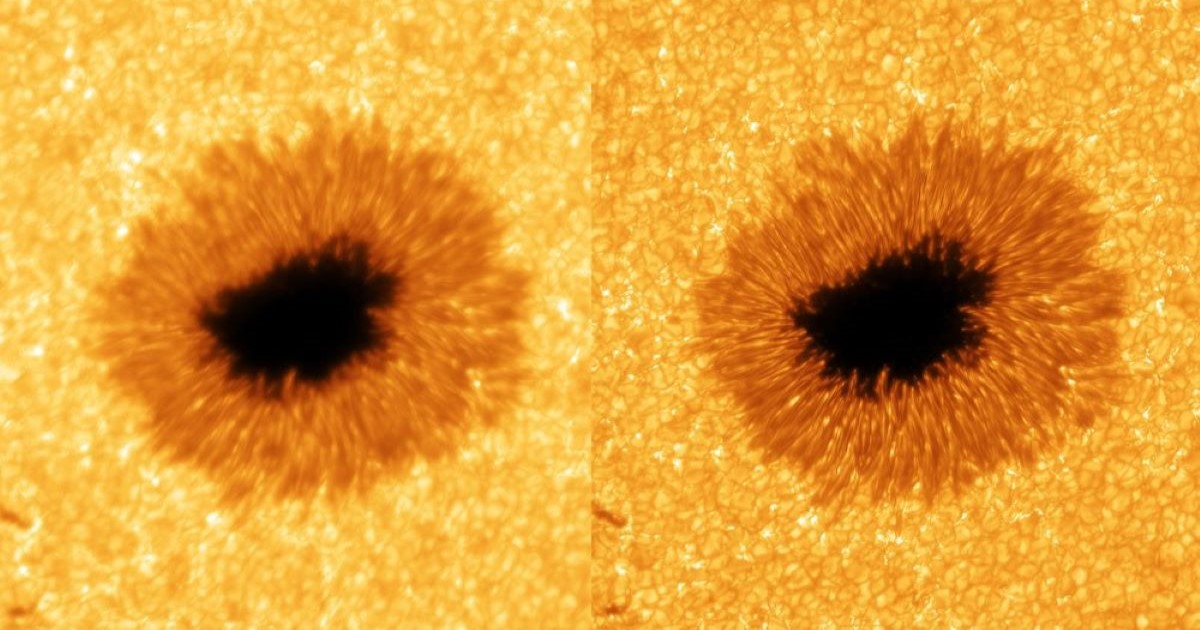
But thanks to a shiny new camera system at Tenerife’s Observatorio del Teide, incredible 8k images of the Sun have now become a reality.


R. Kamlah et al.
With the new images and their processing published in the journal Solar Physics, the world is now able to enjoy – or be horrified by, depending on your viewpoint – these ultra detailed images of sunspots on the Sun.
In fact, these ultra high resolution images, captured by the new cameras on the Observatory’s Vacuum Tower Telescope (VTT), offer the most detailed glimpse of the sun’s fiery surface ever seen.
Recorded at 25 frames per second, the team then use up to 100 8000 x 6000 pixel images to reconstruct 8K resolution images of the Sun, which avoids any interference from the Earth’s atmosphere in the image.
In addition, the much wider view that the technology allows means that not only can we see the Sun in more detail, we can also see more of it than in previous attempts at high-definition photography.


R. Kamlah et al.
In total, the images captured using the VTT show around 200,000 km of the Sun, while also allowing for the identification of tiny details.
As well as being awe-inspiring, the ultra detailed images give us important and sometimes vital information back here on Earth, as Freiburg Institute for Solar Physics scientist Rolf Schlichenmaier explained in a statement:
“In order to better understand solar activity, it is crucial not only to analyze the fundamental processes of the fine structure and the long-term development of global activity with various instruments, but also to investigate the temporal evolution of the magnetic field in active regions.”
Since solar activity – in particular solar flares – can have detrimental impacts to our technology and infrastructure back here on Earth, our greater understanding of the Sun itself and its current activity is extremely helpful in terms of planning and disaster mitigation.
Dangers aside though, there’s no denying that these images are spectacular.
If you thought that was interesting, you might like to read about a second giant hole has opened up on the sun’s surface. Here’s what it means.