


Pixabay
Just under million years ago, an asteroid hit western Finland, resulting in what is now known as the Lappajärvi impact crater.
At around fourteen miles wide and approximately 2,500 feet deep, the crater cannot easily be missed and, despite its age, is still throwing up surprises to the scientists who study it today.
In a recent study from researchers at Linnaeus University, Sweden, has uncovered exactly how the crater became not only a huge lake and popular tourist attraction, but a home to microbial organisms too.
And this new data tells us more than we’ve ever known about how craters can encourage life in a way that is applicable not only on our planet, but across our solar system too.

Henrik Drake, Gordon Osinski
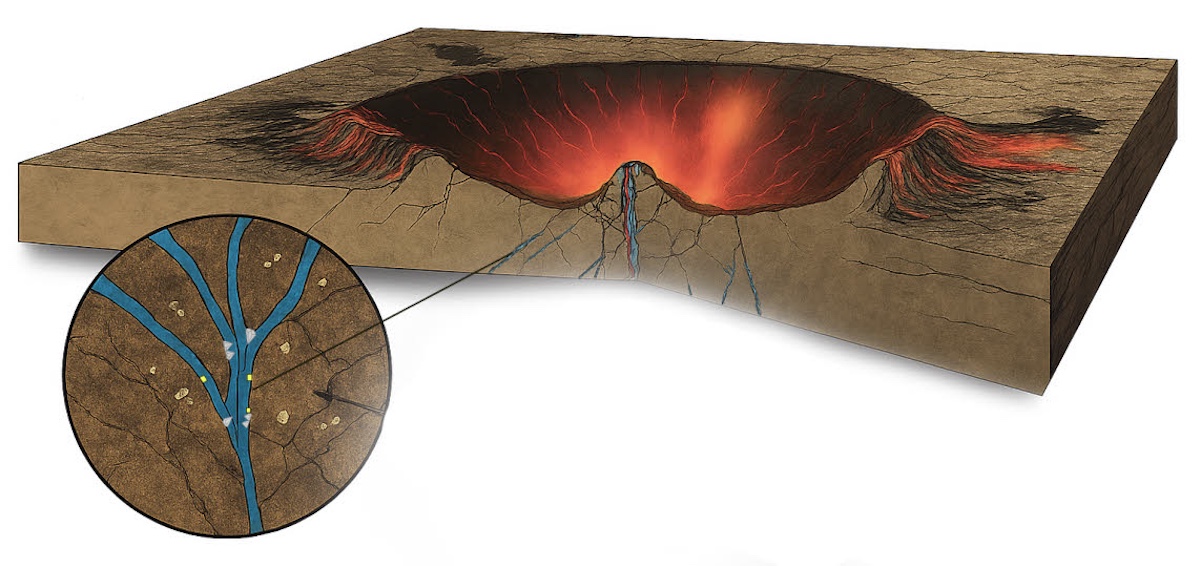
In their study, which was recently published in the journal Nature Communications, the researchers unveiled exactly how the hydrothermal system that was caused by the asteroid impact formed a habitat for microbial life.
But it wasn’t a simple process. Through various advanced techniques the team were able to track a process known as microbial sulfate reduction in the cavities of the crater.
This is significant because this process requires life forms, as Professor Henrik Drake explained in a statement:
“This is the first time we can directly link microbial activity to a meteorite impact using geochronological methods. It shows that such craters can serve as habitats for life long in the aftermath of the impact.”


Henrik Drake, Gordon Osinski
This is not only fascinating, it also changes the way in which we look at our own planet and beyond. That’s because, through radioisotopic dating of the mineral structures, the scientists were able to prove exactly when the microbes first got to work, as Linnaeus’s Jacob Gustafsson continued:
“What is most exciting is that we do not only see signs of life, but we can pinpoint exactly when it happened. This gives us a timeline for how life finds a way after a catastrophic event.”
With this discovery in mind, researchers are now armed with a deeper understanding of how life can form – and thrive – in impact craters, from a short time after their formation to millions of years later.
And this could have far-reaching implications for the possibilities of life on other planets.
If you thought that was interesting, you might like to read a story that reveals Earth’s priciest precious metal isn’t gold or platinum and costs over $10,000 an ounce!