


Pexels/Reddit
Unfortunately, you can’t help every customer, no matter how much you want to.
So, what would you do if a customer with stage 4 Parkinson’s called to request a TV replacement, but the company policy required him to obtain information that was physically impossible for him to obtain? Would you bend the rules to help? Or would you stick to the policy?
In the following story, one call center employee is forced to choose the latter. Here’s what happened.
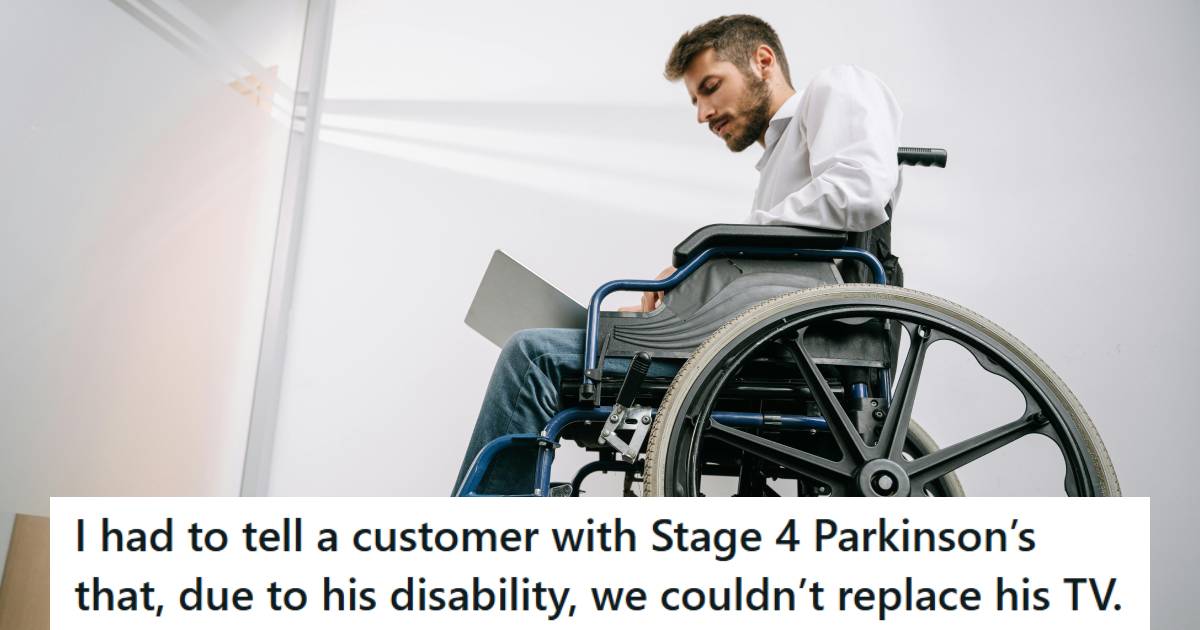
I had to tell a customer with Stage 4 Parkinson’s that, due to his disability, we couldn’t replace his TV.
This customer called because his TV has a large black spot on the screen that won’t go away. Normally, this is something we support, and he has the correct protection tier in order to get a replacement sent to him.
All we needed was the model number and serial number of the device (so we know what the device we’re replacing is) in order to move forward with the claims process.
This customer informed me that we was wheelchair bound due to having stage 4 Parkinson’s. He takes medicine every day that allows him to move around in short bursts so that he isn’t bedridden.
He tried to help the man find the number, but was unable to.
The model number and the serial number were on a sticker on the back of the tv, which was obstructed by the TV stand. He said, “Even if I could actually lift the TV, which I can’t, it would immediately fall because I have Parkinson’s.”
I asked if he had any friends, family members, or neighbors he could ask to help him find it, but he said he lives alone and that his caretaker only comes twice a week.
We tried to find the model/serial number in the TV’s settings, but there wasn’t anything there. So my manager informed me that I had to tell him there was nothing we could do, except factory reset the TV, which would most likely do nothing to fix the problem.
The guy sounded very defeated.
It would, more than likely, make it worse because I doubt he has any of his passwords written down and wouldn’t remember what they are (he said someone else set up those accounts for him). So, even if it worked, he probably wouldn’t be able to access any of the installed apps.
When I told him there was nothing else we could do (in the nicest way I could come up with), he sounded so defeated and lost.
He said, “My TV is the only thing I have. I don’t have a computer or anything else because I can’t afford it. I can’t buy a new tv, because I can’t lift it to set it up, or drive anywhere to buy one. I have nothing, and what I do have is now gone.”
Apparently, he had asked about this very thing and was reassured he’d be fine.
I’m a 27-year-old male, and that almost brought me to tears. I feel so bad for him, and I feel like the world’s biggest jerk for having to break this news to him. It feels selfish to say that this completely ruined my day, because it feels like I, or my company, potentially ruined his way of life.
Before he got off the phone, he told me that the person who sold him this protection plan promised him that we would send someone to his house to help. Which is true, but only for the [CLIENT SPECIFIC] equipment. Not anything else.
He said he asked this person about his specific circumstances, and they assured him it was possible and that we would help.
Wow! It seems like they could’ve done something for him.
Let’s see what the people over at Reddit think about what happened here.
Here’s how this person would’ve handled it.


For this reader, he should’ve tried harder.


This reader feels bad because his grandfather has Parkinson’s.


Interesting point.


He did what he could.
If you liked that post, check out this story about a customer who insists that their credit card works, and finds out that isn’t the case.