
The Full Moon Can Look Huge One Night and Smaller the Next, and There’s a Reason Why

Shutterstock
The moon is, by far, the largest and brightest object in the night sky. It has been studied for thousands of years, and we have a pretty good understanding of most aspects of it today.
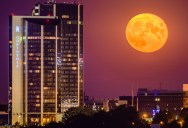
When you look up at a full moon, however, you may have noticed that when it is high up in the sky, it appears a lot smaller than when it is down closer to the horizon.
This is an odd thing since the moon remains the same size, of course, and it isn’t getting closer or further away from the Earth.
If you’ve ever wondered about this, you certainly aren’t the only one. In fact, it has been pondered by people for thousands of years, and it even has an official name, ‘The Moon Illusion.”
Shutterstock
The earliest known writings on this come from Aristotle, who wrote about it in the 4th century BCE. His explination was that the atmosphere of the Earth acts like a magnifying glass for the moon.
When the moon is near the horizon, the atmosphere is denser, he thought, and therefore the moon is more magnified.
While wrong, it isn’t a bad theory, especially for the time.
More modern theories say that the moon illusion is just that, an optical illusion. Since at the horizon there are things like trees or buildings, our brain has more context to work with and ‘tricks’ us into thinking that the moon is closer (and therefore larger) than it is.
This is another great theory, but there is a problem. When astronauts are in space, they also experience the moon illusion. Needless to say, there are no trees or buildings to provide depth in space.
Sign up to get our BEST stories of the week straight to your inbox.
At the end of the day, even modern scientists don’t fully understand what causes the moon illusion. NASA explains:
“In the absence of a complete explanation for why we see it like that, we can still agree that – real or illusion – a giant Moon is a beautiful sight.
Shutterstock
So, until someone puzzles out exactly what our brains are up to, it’s probably best to just enjoy the Moon illusion, and the moody, atmospheric, and sometimes downright haunting vistas it creates.”
Well, if it is good enough for NASA, it’s good enough for me. Figuring out why the moon looks so large and beautiful at the horizon just hasn’t happened yet. Maybe it is better just to leave it a mystery and enjoy its natural beauty.
If you enjoyed this story, check out this study that suggests the climate crisis is negatively impacting young people’s health.





Sign up to get our BEST stories of the week straight to your inbox.
