
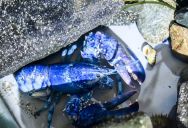
Catching A Blue Lobster Is A 1 In 200 Million Event, So When A Lobster Fishermen Got One He Quickly Donated It To Science

Matthew Modoono/Northeastern University
Lobsters are amazing creatures. They spend their life on the ocean floor cleaning things up by eating the remains of dead animals, as well as capturing and eating small fish and other things.
Technically speaking, lobsters are also immortal in that they don’t get diseases that kill them from old age. Sadly for the lobsters, however, they do eventually become weak to the point where they can’t molt to get a new shell, leaving them trapped inside until they die, but that can take 100 years or even longer to occur.
Most lobsters, of course, never have to experience that difficult death because they are a favorite food of many animals, including octopus, stingray, and humans.
Lobster fishing is a huge industry, and Brad Myslinski has been doing it for years. When he looked in his net and saw electric blue, he was very surprised.
Shutterstock
Lobsters are usually brown, which helps them to blend in with the rocks and sand on the seafloor. Sometimes, however, they have some type of genetic abnormality that can make them another color, including yellow, calico, or even split between two colors.
This particular lobster had a condition that causes it to overproduce crustacyanin, which makes its shell an electric blue. The genetic abnormality that causes this to happen is estimated to occur in about 1 out of every 2 million lobsters, making it very rare indeed.
As you might expect, however, an electric blue lobster can’t hide from predators nearly as well as a greenish brown one, so they often get eaten while young. This means that it is even more unusual for one to survive long enough to get caught in a lobster trap.
Experts suggest that only about 1 in 200 million lobsters are unlucky enough to be electric blue, then lucky enough to survive for very long, and then unlucky enough to get captured in a trap or net.
Given the rarity of this particular lobster, it would not make sense to simply bring it to a restaurant to have it served up as a meal (especially since it would just turn red like every other lobster when boiled). So, Myslinski decided to donate it to Northeastern University’s Marine Science Center (NUMSC). The team there was very happy to take it. PhD student Neida Villanueva at the center said to IFLScience:
“I was really excited to see this rare coloration on a lobster. I never thought I’d get to see a blue lobster in person, considering how rare they are. The lobster fisher, Brad Myslinski, who caught and donated Neptune, was very kind to do so. We are all very excited about this new addition to our outreach program.”
Shutterstock
This lobster, named Neptune, is estimated to be about 7 years old, which means the NUMSC could care for him for a very long time. Villanueva commented on this, saying:
“I think Neptune’s coloration offers a great opportunity to get students and visitors interested and asking questions about lobsters in general. The lobster industry is so vital to New England, so any discussion and interest about it is great.”
So, if you’ve ever wanted to see one of the rarest lobsters in the world, perhaps you will want to plan a trip to the NUMSC. But you’ve got plenty of time to do it.
If you thought that was interesting, you might like to read a story that reveals Earth’s priciest precious metal isn’t gold or platinum and costs over $10,000 an ounce!





Sign up to get our BEST stories of the week straight to your inbox.
