
This Giant Amphipod Thrives Under Pressure, Living Deep On The Ocean Floor

Hadal Zone via Wikimedia Commons (CC BY-SA 4.0)
The ocean is massive, and there are creatures living in virtually every part of it. From huge whales to tiny plankton and even microorganisms, the oceans of Earth are a huge ecosystem that is home to a very diverse population. Many animals in the ocean live only in one region of the ocean, such as a tropical area where the waters are warm, or an arctic one where they are nearly freezing.
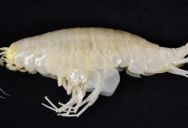
One animal, however, takes a different approach. The Alicella gigantea, which is described as a supergiant amphipod, lives on the seabed of the ocean, digging in the sand and coming up to eat. Unlike more specialized animals that stay in specific regions, this shrimp-like creature has spread out over as much as 59% of the ocean.
Since they are difficult to study due to the depths at which they live, it is believed that much of their food comes in the form of dead animals that drop to the bottom of the ocean from above.
There is a lot of pressure on these creatures, literally. Living at depths ranging between 3890 and 8931 meters (12,762 – 29,302 feet), there is an actual ocean of water above, pushing down on their bodies. In addition, they live in near-perfect darkness due to this depth. This may be why they are very pale, almost completely white, in color.
They are also a lot larger than amphipods that live further up. This one can reach up to about 34 centimeters (13 inches) in length. Their body is long and laterally compressed, possibly due to the pressure on them and how they position themselves throughout their life.
P Maroni et al, Royal Society Open Science 2025 (CC BY 4.0)
A new study was recently published about them in the journal Royal Society Open Science. It was completed at the University of Western Australia in Perth, and looked at 200 records of this animal, coming from 75 locations throughout the Pacific, Indian, and Atlantic oceans. This is how it was determined that it lives in as much as 59% of the planet’s ocean floor. The authors of the study wrote:
“This finding confirms that the supergiant amphipod is far from ‘rare’ but instead represents a single, globally distributed species with an extraordinary and expansive range across the deep sea.”
Scientists have long been interested in this animal, with a previous study being done in 2021 looking at their DNA. This study found that they have specialized genes that are known to help with things like energy conservation, pressure tolerance, and starvation resistance, all of which are essential when living in the harsh conditions at the bottom of the ocean.
While a lot of attention from researchers is given to animals that are endangered or extinct, it is good to study those animals that are thriving to see what they are doing right.
It might seem obvious in this case to point out that one of the things this supergiant amphipod is doing correctly is living in an ecosystem that is extremely difficult for humans to access.
Thought that was fascinating? Here’s another story you might like: Why You’ll Never See A Great White Shark In An Aquarium





Sign up to get our BEST stories of the week straight to your inbox.
