
The Future Of Warfare May Include Swarms Of Robotic Insects And Other Tiny Animals According To Investments From DARPA

Shutterstock
If you want to know what the future of warfare is going to look like, an easy way to find clues is to look at what the US Defense Advanced Research Projects Agency (DARPA) is paying attention to.
This organization is constantly working on making sure that the next generation of defense and weapons technologies are developed by and for America, and they have done a very good job overall.
So, when you see that this agency has been giving a lot of attention to tiny robots based on insects and other small animals, you can bet that these things will be used in the wars of tomorrow.
Even The National Interest, which is a US national security focused magazine, has done stories on these efforts.
So, what type of robots are in the works?
Well, to start with, the RoboBee has been under development since at least 2009 when Harvard’s Wyss Institute got a $9.3 million grant from the National Science Foundation. This is a bug-like flying vehicle that can supposedly transition from flying into the air to swimming in the water. In addition, it is able to land on various surfaces, and even automatically avoid collisions so that it can be used in dense areas. On top of that, this RoboBee is said to be able to operate in swarms.
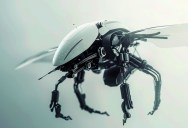
There are also reports of robotic ‘insects’ that are designed after flies, unicorn beetles, cockroaches, and more. Various types of insect designs may be needed not just so they can blend in with whatever local insect life is present on a given operation, but also to accomplish different things.
Shutterstock
A larger beetle, for example, may be able to transport heavier things like HD cameras, microphones, or possibly even explosives. On top of that, larger beetles would have room for larger batteries, which means longer flights or other operations.
Smaller insects like flies, on the other hand, can more easily avoid detection and may be able to move more quickly.
Insects aren’t the only things that are being worked on though. There are also reports of different water-based animals that could serve many uses. A ‘robo-jelly’ is a robotic jellyfish that could silently move through the waters to track things like ship (or even submarine) activity along the coasts.
In addition to obvious military uses, having robotic underwater animals could also help to monitor things like oil pipelines or massive transoceanic internet fiber lines. Being able to monitor for damage so that problems can be fixed (or avoided) could save billions.
Overall, the future of microscopic robotics seems very bright. Though I’m not sure I want to live in a world where I have to watch out for robotic mosquitoes.
If you thought that was interesting, you might like to read about a second giant hole has opened up on the sun’s surface. Here’s what it means.





Sign up to get our BEST stories of the week straight to your inbox.
