
Two Black Holes Collide While Being Pulled Into Another Nearby Supermassive Black Hole For The First Time Ever Observed

Shutterstock
Black holes are incredible objects that are so massive that they can pull everything, including light, into them. Even for huge things like this, however, there are levels, and a black hole can be anywhere from relatively small (for a black hole) to unimaginably huge.
In 2019, researchers detected gravitational waves that indicated that two black holes were merging. These were two fairly small black holes, one being just 23 times more massive than our Sun, and the other, even smaller, at about 2.6 times more massive than our Sun.
As the event was taking place, researchers were looking at all the data that they could get their hands on, but things just weren’t the way they expected them to be. Soon, however, the researchers figured out why.
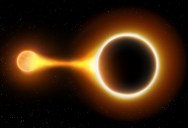
These two small(ish) black holes were actually pulled together not by each other, but by a third supermassive black hole. The two smaller ones were actually near the accretion disk of a much bigger one that was forcing them into itself, resulting in them merging in the process.
Shutterstock
It was difficult to prove that this is what was going on since it happens so far away, and very little data can escape black holes at all. Fortunately, the researchers figured out that if their theory was right, it would create a specific Doppler effect in the line-of-sight acceleration, which is what they observed.
The linear acceleration was .002 c s-1, with C being the speed of light. Once they worked out the math, they found that this object had a gravitational pull that is over 61,000 times stronger than Earth’s. In a statement about the study, Dr. Han Wenbiao from the Shanghai Astronomical Observatory said:
“This is the first international discovery of clear evidence for a third compact object in a binary black hole merger event. It reveals that the binary black holes in GW190814 may not have formed in isolation but were part of a more complex gravitational system, offering significant insights into the formation pathways of binary black holes.”
Shutterstock
This study, which was published in The Astrophysical Journal Letters, will show how to look for similar events in the future. Monitoring the areas around supermassive black holes may reveal that smaller black holes merging together is something that happens much more often than previously believed.
If you think that’s impressive, check out this story about a “goldmine” of lithium that was found in the U.S. that could completely change the EV battery game.





Sign up to get our BEST stories of the week straight to your inbox.
