
Rapid Evolution Of Fungi In Cheese Caves Has Been Discovered, And It May Help Improve Food Production

Shutterstock
When people think of science, they picture people in lab coats working on specific projects in a very rigorous way. While that certainly does happen, it is just as common for a series of unlikely events to lead to an interesting scientific discovery.
In 2016, Tufts University associate professor of biology Benjamin Wolfe tricked his former post-doctoral advisor, Rachel Dutton, into taking a trip to Jasper Hill Farm in Vermont. He told her that he needed to collect some samples of Bayley Hazen blue cheese for work he was doing, but in reality, he did it so that her boyfriend, Charlie Kalish, could propose.
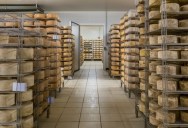
While the main reason for the trip was the proposal, the professor did get the cheese samples he needed from the caves under the facility. These caves are filled with cheese since it can age there safely due to the proper temperature and humidity levels.
Normally, once the necessary research is done, samples will be thrown away, but that is not the case. In a statement about what happened, Wolfe explained:
“I’m notorious for not throwing samples away just in case we might need them.”
So, that cheese sample sat around in his storage area.
Years later, graduate student Nicholas Louw went back to the same cheese caves to get new samples. These new samples, however, were different. Originally, the cheese was covered with the green fungus Penicillium solitum. This is normal in the aging of cheeses. The new sample, however, had a white fungus on it.
Shutterstock
There were two main possibilities about what happened. First, the fungus could have evolved in some way that made it white rather than green. The second option was that a different strand of fungus became dominant and pushed the green out entirely.
After examining the new samples, it was determined that the new samples had the same fungus, but it had evolved and was no longer green.
The team looked closely at the fungus and found that there were several different mutations that had taken place. The relevant one to its color was alb1, which is a gene involved in the production of melanin. Louw explained:
“You can think of melanin as an armor that organisms make to protect themselves from UV damage. For the fungi, it creates the green color that absorbs UV light. If you are growing in a dark cave and can get by without melanin, it makes sense to get rid of it, so you don’t have to expend precious energy to make it.”
Since the fungus does not need protection from the sun in a cave, it evolved to get rid of it. He goes on:
“By breaking that pathway and going from green to white, the fungi are essentially saving energy to invest in other things for survival and growth.”
Shutterstock
This is not just an interesting bit of science. As much as 40% of food produced in the world is wasted, largely due to it spoiling either while being grown, during transport, or while waiting to be consumed.
Understanding how wild mold and fungus can evolve to grow and be stored could help to reduce this waste, allowing food to be more readily available to people around the world.
Their findings were published in the journal Current Biology.
If you thought that was interesting, you might like to read a story that reveals Earth’s priciest precious metal isn’t gold or platinum and costs over $10,000 an ounce!





Sign up to get our BEST stories of the week straight to your inbox.
