
Researchers Identify Switchback Events Within Earth’s Magnetosphere For The First Time, Making Future Studies Of These Events Possible Much Closer Than Ever Before

Shutterstock
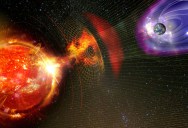
As the Earth cruises through space, it is constantly being bombarded by charge particles and cosmic rays that are shot out from the sun. Fortunately, the Earth has a magnetosphere, which works as a protective shield to deflect these potentially harmful phenomena.
In the past, there have been odd events that have been seen in the sun’s magnetosphere known as magnetic switchbacks. They are zigzag motions of the cosmic particles that aren’t extremely well understood. Up until recently, studying them further has been difficult because they occur quite far away from the Earth, closer to the sun.
A new study published in the Journal of Geophysical Research, however, is changing that. The study took data from four unmanned spacecraft that are used for NASA’s Magnetospheric Multiscale Mission (MMS) and analyzed how the Earth’s magnetosphere interacts with the magnetic field of the sun.
Shutterstock
Astrophysicist Emily McDougall conducted the study at the University of New Hampshire. During her work, she saw the classic zigzag shaped plasma structures within the magnetosheath, which is a layer that exists just past the magnetosphere. This is where diverted solar winds flow.
She was able to identify that the switchback contained high-energy electrons, which it looks like came from the Earth’s magnetic field rather than the sun’s.
This is the first time that a switchback was confirmed to exist in an area this close to the Earth. The implication is that additional study on these events can now be done far more easily since it won’t be necessary to send a probe so far into space.
In fact, the MMS team can now use the existing probes into the area to gather more data and hopefully observe the events again. Learning how switchbacks develop and what energy conditions are most likely to trigger them is important work.
Shutterstock
Large energy events can cause geomagnetic storms, which can have a direct impact on the Earth. Specifically, they can cause problems with power grids, radio signals, and even put spacecraft and satellites around the earth at risk. When they aren’t too strong, however, they just produce beautiful displays of the Aurora Borealis, so there is that to enjoy.
If you found that story interesting, learn more about why people often wake up around 3 AM and keep doing it for life.





Sign up to get our BEST stories of the week straight to your inbox.
