
Rust Detected On Asteroid Is Made Of Highly Valuable Metals, And A NASA Spacecraft Is On The Way To Investigate Further

The asteroid “16 Psyche,” which orbits between Jupiter and Mars is of particular interest to people here on Earth for a number of reasons. For most people, it initially got a lot of attention because it is made of valuable metals, including iron and nickel, among others.
It is about 140 miles across, and at today’s prices, the metals that make up this asteroid would be worth about $100,000 quadrillion if it were brought to Earth. Of course, if all this metal was brought to Earth, it would crash the market prices of the metals in question. But the point is, this asteroid has a lot of metal in it.
According to a new paper that has been accepted into the Planetary Science Journal, however, the asteroid might be getting rusty.
NASA’s James Webb Space Telescope took images of the asteroid, which were then studied by a team of researchers. They found hydroxyls as well as bonded oxygen and hydrogen atoms, which are the same as have been found on other meteorites that have rust, water, and carbon on them.
It is believed that a closer study of the rust on this asteroid could provide information about the history of the object itself. Scientists currently hypothesize that the asteroid may have had meteorites carrying the necessary chemicals impact it at some point in the past. Another option is that 16 Psyche came from somewhere outside the asteroid belt in the distant past, carrying with it the chemicals in question.
This may even be one of the same large objects that formed the rocky planets in the solar system, including Earth, billions of years ago.
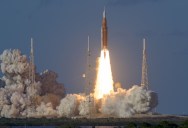
Learning more about this asteroid is important enough that NASA launched a spacecraft, also dubbed 16 Psyche, in October of 2023 to get some close-up data. The spacecraft is scheduled to arrive at the asteroid in 2029.
Sign up to get our BEST stories of the week straight to your inbox.
You can learn more about the mission to 16 Psyche on this informative video:
Maybe that spacecraft can bring back a few billion dollars worth of the metal for us?
Thought that was fascinating? Here’s another story you might like: Why You’ll Never See A Great White Shark In An Aquarium







Sign up to get our BEST stories of the week straight to your inbox.
