
Paleontologist Unearths A Fossil In Texas With A Striking Resemblance To Barney The Dinosaur

Texas Through Time Fossil Museum
Given how many species and individuals came before us, it’s unsurprising that fossils finds are a frequent occurrence.
In fact, new species are named from their fossilized remains every few weeks, so it’s understandable that not every fossil makes the headlines.
However, every once in a while, a newly-unearthed fossil strikes the hearts of researchers and the public alike, whether due to its condition or its striking appearance.
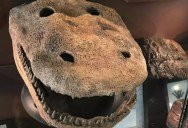
And after being recovered from North Central Texas, the near-complete skull of an ancient amphibian known as an Eryops megacephalus is absolutely the latest of these awe-inspiring finds.
Why? Well because of its striking resemblance to Barney the Dinosaur.
Texas Through Time Fossil Museum
Unearthed by palaeontologist Andre LuJan, from the Texas Through Time Fossil Museum, the 280 million year old fossil was found after heavy rains in Permian Quarry, Archer County.
And though this is not a rare species, the condition of the amphibian’s skull makes it quite remarkable, as LuJan explained to Houston’s Chron:
“This is an exciting discovery. It’s a well-known animal and not considered rare, but this discovery is significant because even though it’s damaged, it is nearly complete, and that is far more uncommon or even rare than finding fragments.”
Thanks to their thin skulls, it’s unusual to find an Eryops megacephalus skull in such good condition; instead, they’ve usually cracked and collapsed under the pressure of Earth and time above them.
But palaeontologists, amphibian experts, and the hearts of the public around the world will be overjoyed by the sheer luck that this Eyrops skull stood the test of time.
Texas Through Time Fossil Museum
As Chron explain, the amphibian is quite unusual, whilst also embodying many of the traits that we see in amphibians and reptiles to this day:
“The genus name Eryops means ‘drawn-out face,’ and megacephalus translates to ‘large-headed,’ referencing the animal’s broad skull. Its wide jaws and palatal teeth suggest it could not chew and instead swallowed prey by tossing its head back, similar to modern alligators and crocodiles.”
And for those who can’t resist seeing it in person, there’s good news. After a year of careful cleaning and restoration, Texas Through Time Museum will 3D scan the fossils so that replicas can be provided for both exhibition and study across the world – meaning that in the future, a replica of this adorable fossil could be in a museum near you.
For now, our hearts must be contented with the photos of perhaps the most adorable fossil ever unearthed.
If you thought that was interesting, you might like to read about the mysterious “pyramids” discovered in Antarctica. What are they?





Sign up to get our BEST stories of the week straight to your inbox.
