
Astronomers Identify What May Be The Largest Black Hole In The Universe

Shutterstock
Black holes can be incredibly big, which makes it somewhat difficult to compare them to each other since it is weird to think that one black hole that is literally what holds a galaxy together is ‘small’ compared to anything.
The fact is, however, that the mass of black holes varies greatly out in the vast universe, and astronomers have recently discovered what they believe may be the biggest one ever found. They estimate that it has a mass 36 billion times greater than our sun. It could be 10,000 times heavier than the black hole at the center of the Milky Way.
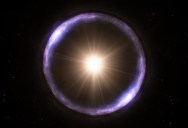
The researchers were able to get an idea of how big it is by the fact that the light emitted from a galaxy located directly behind it (from our perspective). The light from that galaxy was pulled in by the gravity of the black hole, making a near-perfect circle around it. This circle is known as an Einstein ring.
Shutterstock
Astronomers published a study about this black hole in the journal Monthly Notices of the Royal Astronomical Society. Thomas Collett is a professor of astrophysics at the University of Portsmouth and a coauthor of the study. In a statement, he said:
“This is amongst the top ten most massive black holes ever discovered, and quite possibly the most massive.”
This black hole is likely very old since it needs time to gather so much mass. The black holes of this type are often called fossil black holes because of their believed age. Collett commented:
“So we’re seeing the end state of galaxy formation and the end state of black hole formation.”
Interestingly, this black hole is located in the famous Cosmic Horseshoe, which is a massive area in space that had long been believed to have a large black hole, but it was not proven given its distance from Earth.
The astronomers were fortunate that they could see it from the light coming from the distant galaxy. Currently, this black hole is considered to be inactive since it does not appear to be pulling matter in from the surrounding area. Normally inactive black holes can’t be detected at all. Carlos Melo, the lead author of the study, is from Universidade Federal do Rio Grande do Sul in Brazil. In the statement, he commented on this:
“Typically, for such remote systems, black hole mass measurements are only possible when the black hole is active.”
Melo went on to talk about the method used in this study, saying:
“What is particularly exciting is that this method allows us to detect and measure the mass of these hidden ultramassive black holes across the universe, even when they are completely silent.”
Shutterstock
So, while what was learned about this ultramassive black hole is incredible, the study really helps to prove additional possibilities when it comes to finding and measuring distant black holes in the future.
If you thought that was interesting, you might like to read about a second giant hole has opened up on the sun’s surface. Here’s what it means.





Sign up to get our BEST stories of the week straight to your inbox.
