
Critically Endangered Western Nimba Toad Is The Only Known Amphibian That Gives Birth To Live Young

Dr Laura Sandberger-Loua (CC BY 4.0)
There are thousands of different species of amphibians, including many different types of frogs and toads. One thing that almost all of them have in common is that their lifecycle begins as eggs, then they develop into tadpoles, then froglets (or toadlets), and finally become the adult form of their species.
This has shown to be a very effective way for them to reproduce as there are many amphibians that live in ecosystems around the world.
For one species, however, following this pattern just wasn’t good enough. Instead, they took a page out of the mammalian book and evolved to give birth to live young that are fully developed.
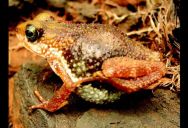
This species is the Western Nimba toad (Nimbaphrynoides occidentalis). It lives in the Mount Nimba region of West Africa, which is within LIberia, Cote d’lvoire, and Guinea.
When it comes time for this toad species to reproduce, the female becomes pregnant in the traditional method, but then rather than laying eggs, she keeps her young within her womb just like a mammal.
The young toad develops for 9 months, which is astonishingly long for an animal like this, before it is time for mom to give birth. When ready, the mom toad has to get into a specific birthing posture where she places her legs into a double W position so that her young can emerge.
Dr Laura Sandberger-Loua (CC BY 4.0)
This is essential because the toad does not have the ability to push the young out due to not having the musculature necessary. In addition, experts suggest that the young toads may also have to actively work with the mother to emerge. This is believed because when juveniles died during delivery, they generally got stuck, resulting in the mother dying of sepsis.
This unique lifecycle was studied in a 2017 paper where the authors found that this likely evolved due to the difficult environment where this toad lives. In the paper, they explained:
“It is likely that the harsh unpredictable environment and scarcity of open water promoted viviparity in Nimba toads, or supported the survival of this unique reproductive mode in these special and isolated conditions. Considering their complex life cycle, in which reproductive and seasonal cycles are tightly linked, understanding and protecting the Nimba toad’s threatened environment is of utmost importance.”
Unfortunately, these toads are critically endangered. Effort has been made to protect the ecosystem where they live, including having the region listed as a UNESCO World Heritage Site. Keeping this environment safe, however, is not easy because a lot of mining and other environmentally harmful activities also take place in the region.
If you thought that was interesting, you might like to read a story that reveals Earth’s priciest precious metal isn’t gold or platinum and costs over $10,000 an ounce!





Sign up to get our BEST stories of the week straight to your inbox.
