
The Goblin Shark Isn’t Just Ugly, It Has The Fastest, Most Terrifying Jaws In The Ocean

Shutterstock
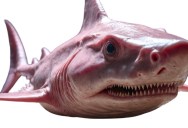
The ocean is an amazing, but terrifying, place. There are many animals that are beautiful, and no shortage of those that are downright ugly. The goblin shark, as the name implies, falls into that second category.
It was first discovered in 1898 in the waters off Japan. Very few people have ever seen a goblin shark, however, because they live quite deep in the water. Spending most of their lives between 250 and 900 meters (820-2950 feet) below the surface, this is no place for a person to be swimming.
This depth is called the benthopelagic zone, which is very dark because almost no light can penetrate that deep. The goblin shark patrols this area, swimming relatively slowly, trying to find its next meal.
Given its slow swimming speed, one might assume that it has a hard time catching prey, but that is not the case. If any fish gets anywhere near its mouth, it is in incredible danger, no matter how much faster it might be than the shark.
This is because the goblin shark has a secret weapon. The fastest jaw in the ocean. While this may sound odd, it is actually a very helpful weapon when hunting for fish. When the shark detects prey in front of it, it can trigger its jaw to eject out of its mouth, clamping down on the unsuspecting fish. The jaw extends out between 8.6-9.4% of the length of its body, which is quite impressive when you consider that they are normally about 10-12 feet long.
The jaw can extend out at a speed of about 3.1 meters (10 feet) per second. You can see the jaw in action in this brief video:
This ability was first analyzed in a 2016 study, which dubbed the feeding technique “slingshot feeding” because the jaw rockets out of the mouth like a slingshot.
With it being so dark down this deep in the ocean, the goblin shark relies on sensory pores on its snout, which are extremely concentrated. The organ allows the shark to detect very faint electrical signals, which come from the heartbeats or nervous system of its prey.
Once it determines that its prey is within striking range, it attacks, and in just a fraction of a second, the shark is enjoying its next meal.
Thought that was fascinating? Here’s another story you might like: Why You’ll Never See A Great White Shark In An Aquarium





Sign up to get our BEST stories of the week straight to your inbox.
