
When You Look At A Globe, All The Land Of The Earth Is Bunched Up On One Side, But Why?

Shutterstock
There was once a time when almost every house had a globe in it, but since the Internet came about, they have gone down dramatically in popularity.
This may be one of the reasons that if you ask most people how the land that makes up the Earth is distributed, they would likely say that it is distributed more or less evenly. Of course, there is a lot more water than land, but the continents of the world break it up nicely.
In reality, however, that is not at all the case.
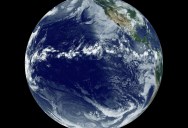
If you pull out a globe, or better yet, take a quick trip up into space, you would quickly notice that the land of the world is actually pretty much bunched up on one side of the planet.
This is most obvious when you are looking at the Earth (or a globe) from above the South Pacific. If an alien were in space looking down at the planet for the first time from this area, they would likely assume that the entire planet was covered with water because that is basically all they would see.
The Pacific Ocean is so big that there are some points where if you drew a line from the surface of the water straight down through the center of the Earth and out the other side, you would still be in the Pacific Ocean.
Why is it like this?
Shutterstock
To put it simply, the land just happens to be like that right now when we are able to observe it. If you looked at the Earth millions of years in the past, or millions of years in the future, this may not be the case.
This is due to continental drift, which is the process by which all of the tectonic plates move around the planet. They move quite slowly, but over long periods of time, they shape the layout of the land.
Every 300-500 million years, the continents seem to bunch up into what is called a supercontinent. At this point, most of the land is all touching. From there, it slowly breaks apart and moves away in massive ‘chunks,’ which is what we are seeing now.
If you measure the movement of the landmasses today, you would find that they are moving away from each other. So, in tens or maybe hundreds of millions of years, it may be that the Pacific Ocean is more broken up by land than it is today.
So, while it may seem like we are all spread out away from each other, the reality is that all people are living in relatively close quarters. Maybe we should try to get along a little better.
If you thought that was interesting, you might like to read a story that reveals Earth’s priciest precious metal isn’t gold or platinum and costs over $10,000 an ounce!





Sign up to get our BEST stories of the week straight to your inbox.
