
Humans Have Been Seeing Unusual Flashes On The Moon For More Than 1,000 Years, And Experts Still Can’t Figure Out What Causes Them

Shutterstock
Since the dawn of humanity, people have loved looking up at the moon in the night sky. It has sparked endless stories and even shaped the way calendars in many civilizations have been made. Of course, it is also responsible for the tides and many other important things here on Earth, so to say that it is an important part of our day to day life is an understatement.
While stargazing isn’t quite as popular today as it used to be (in part, perhaps, because of all the light pollution we have in modern times), there are still millions of people who look up at our cosmic companion in awe.
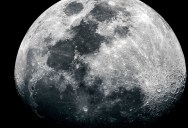
If you’ve ever looked up at the moon and seen a flash of light, you might have thought it was odd or that you were crazy, but the fact is, this is an experience people have been having for at least a thousand years, and likely much longer. In fact, the first time it was written about was in the sixth century CE.
A paper discussing the many reports of this phenomena throughout history, which were dubbed lunar transient phenomena (LTP) tracks the many accounts of people seeing it.
“Literature and received reports of lunar transient phenomena (LTP) in lunar programs of observations provided a collection of 2,254 total observations, from 557-1994 [CE] with sufficient information for auxiliary data analysis. Among the 2,254 there were 645 that were independently confirmed and/or permanently recorded in photographs, spectra, photometry, and polarimetry. These are designated by +. In study of these reports 448 were found that could not be explained by terrestrial atmospheric or instrumental effects, so are probably intrinsically lunar and are designated * and + for those confirmed or permanently recorded *+.”
For a long time, it was mostly ignored by the scientific community, and even dismissed as just people seeing things or a mistake that people made when they saw a terrestrial light that appeared to be on the moon.
Today, however, it has been witnessed by many reputable people, and even recorded or photographed, as can be seen in this video:
In 1939, an amateur astronomer and science communicator, Patrick Moore, witnessed them.
He was quoted in a 1977 paper about the events:
“There has been a great deal of recent discussion about t.l.p. or transient lunar phenomena. My only qualification for discussing them is that I have been watching for them over a period of almost forty years, and have recorded several, but it was only in recent years that they have been accepted as real.
They take various forms. Some are merely local obscurations, hiding surface detail which is normally visible; others are obviously coloured, generally red. The classic observation was made by Kozyrev in 1958, who recorded a red t.l.p. in the crater Alphonsus and obtained confirmatory spectrograms. His interpretations have been disputed, but there can be little doubt that an event of some sort took place.”
So, what are they?
The short answer is, we don’t know. But they are being investigated.
From 2017 to 2023 the Near-Earth object Lunar Impacts and Optical TrAnsients (NELIOTA) instruments from the European Space Agency monitored the moon closely during the times of the month when it is not illuminated. They took 90 hours of observation, and during that time, 55 events were detected.
Shutterstock
Some theories are that radon gas was coming up from below the surface of the moon and causing the light. Other people say that it could be something in Earth’s atmosphere that cause something of an optical illusion that makes it look like it is on the moon. Still others say that it is meteorites crashing into the surface.
In the end, however, the fact is that it is not known. It may actually be all of these things and more that combine to make the lights, or it could be something else entirely.
Even after thousands of years of being amazed by the moon, it still holds many mysteries for us down on Earth.
If you thought that was interesting, you might like to read about a quantum computer simulation that has “reversed time” and physics may never be the same.





Sign up to get our BEST stories of the week straight to your inbox.
