
New Study Confirms The Legend That The Massive Moai Statues Of Rapa Nui “Walked” To Their Current Locations

Shutterstock
While people often think of ancient humans as being simple-minded, a quick look at their accomplishments can immediately rule that out.
Ancient people from around the world built things like the pyramids, Stonehenge, and the Moai human figures in Rapa Nui, among many others. And they did it all without machines or technology, and while surviving a world that was much harsher than the one we live in today.
It remains a mystery exactly how some of these amazing things were built and moved in ancient times, but there are always stories or legends of how it was done, even if they are often unbelievable.
If you ever visit the monolithic human figures in Rapa Nui, you will undoubtedly hear the local legends that say they simply walked to their current locations. While this sounds like a fairy tale, it turns out that it might have some truth to it after all.
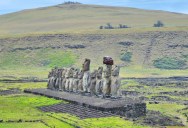
There are 900 of the figures, which were carved and moved into place between 1250 and 1500 CE. The tallest of the figures is 10 meters (33 feet) high and weighs 82 metric tons. The heaviest one comes in at 86 metric tons.
Shutterstock
So, needless to say, these things weren’t just carried around. Even with modern technology, it would take some very heavy equipment and plenty of time to move them where they need to go.
A team of researchers set out to see if the very popular legend that they walked to where they needed to be could be true. They used computer models to figure out how it could be done.
What the modeling came up with was that if ropes were tied to the figure near the top and then people positioned themselves around it, they could ‘walk’ the statue in whatever direction they wanted by wobbling it back and forth.
Emboldened by the data, the researchers created a small replica (it was still 4.35 tons, so not THAT small) and had 18 people work together to test the theory.
It worked flawlessly.
They published their findings in the Journal of Archaeological Science. The lead author, Bringhamton University Professor of Anthropology, Carl Lipo, talked about their findings in a statement, saying:
“The physics makes sense. What we saw experimentally actually works. And as it gets bigger, it still works. All the attributes that we see about moving gigantic ones only get more and more consistent the bigger and bigger they get, because it becomes the only way you could move it.”
The study also looked at potential explanations for why the statues were made. This may have been a part of their road-making efforts (either to help make the road, or a ceremonial element of the process). Lipo explained:
“Every time they’re moving a statue, it looks like they’re making a road. The road is part of moving the statue. We actually see them overlapping each other, and many parallel versions of them. What they are probably doing is clearing a path, moving it, clearing another, clearing it further, and moving it right in certain sequences. So they’re spending a lot of time on the road part.”
Shutterstock
While the method of walking the statues is not 100% certain to be the way it was done, the overwhelming evidence seems to point in that direction. Lipo invites people to present evidence that this is not the case, saying:
“Find some evidence that shows it couldn’t be walking. Because nothing we’ve seen anywhere disproves that. In fact, everything we ever see and ever thought of keeps strengthening the argument.”
It turns out, sometimes local legends are based in truth.
If you think that’s impressive, check out this story about a “goldmine” of lithium that was found in the U.S. that could completely change the EV battery game.





Sign up to get our BEST stories of the week straight to your inbox.
