
This Innocent-Looking Flower Is Actually A Rare, Meat-Eating Plant – And Its Conservation Has Received A Welcome Boost As It Has Popped Up Somewhere Quite Unexpected

Thilo Krueger
It’s a bucket list destination for many, but there’s no denying that Australia’s wildlife can be a little intimidating to say the least.
Thanks to its remote island location, Australia is a hotbed of biodiversity, with incredible plants and animals that you can’t see anywhere else in the world running wild and free.
Where else can you see flocks of wild cockatoos and white ibis roaming the streets in the same manner as pigeons anywhere else; what other country has koalas in its trees, kangaroos hopping through its grasslands and crocs marauding through its waterways?
The crocs are just part of the reason that Australia’s wildlife has a bit of a dangerous reputation – after all, with sharks and box jellyfish in its oceans and deadly snakes and spiders on its land, the country has travellers on their guard to say the least.
Australian Wildlife Conservancy
With all this in mind, it’s probably unsurprising to know that things are alarming in the plant world too, with Western Australia known as the world’s centre of diversity for carnivorous plants – or, in other words, plants that are meat-eaters.
In fact, there are over 150 of these such plants in south Western Australia, with many of them endemic to this area and, as a result, plenty of them endangered or vulnerable thanks to the risk of habitat loss and climate change.
But in good news for one of these species, known as Drosera silvicola, as it seems to be thriving in a new habitat, against all odds.
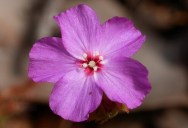
The plant, which displays pink flowers, is not as formidable as it sounds, with its diet composed of tiny insects which it uses its leaves to capture.
Previously, Drosera silvicola was regarded as one of the rarest carnivorous plants in the state, with only two populations previously identified. But as the Australian Wildlife Conservancy explain in a statement, a third population has finally been found.
Amanda Bourne/AWC
This was all thanks to the hard work of a team of scientists and volunteers from Paruna Wildlife Sanctuary who decided to take a detour from their planned route in search of the plant – which oddly, is 70km away from the two other known populations.
But the plant has a history in the area, as expert Thilo Krueger explained in the statement:
“We knew it was previously recorded in the area over 30 years ago but given we had already searched for nearly two full days I had started to doubt the validity of that old record. The area had ridges and slopes that sat high up,” he explained. “It was in the Jarrah Forest, but it was an open area with very little leaf litter – the perfect environment for the species. I was so excited when I first spotted the plant out of the car window, I jumped out of the door fist pumping the air and threw myself on the ground next to it.”
Krueger’s excitement is more than understandable, since this plant is high-priority for conservation; if the other two populations were to die out, there would be no known Drosera silvicola in the world – so another population of the plant, some distance away, is reassuring to say the least.
Unless you’re a small insect, of course.
If you thought that was interesting, you might like to read about why we should be worried about the leak in the bottom of the ocean.





Sign up to get our BEST stories of the week straight to your inbox.
