
Will A Bowl Of Salt Near The Window Really Help To Prevent Condensation From Occurring?

Shutterstock
In the winter, you may find that the windows in your home become moist or even have droplets of water forming on them. This is a common issue caused by condensation. If it only happens occasionally and it doesn’t result in a lot of water, it may not be a big deal, but in some cases, it can cause mold or window panes to rot.
Understanding what condensation is and how it occurs can help you to get to the root cause of it in your home so that you can take steps to keep it under control. The National Oceanic and Atmospheric Administration (NOAA) has a post about condensation, which explains:
“Condensation is not a matter of one particular temperature but of a difference between two temperatures: the air temperature and the dewpoint temperature. The dew point is the temperature at which dew can form – it is the point at which air becomes saturated and can not hold any more water vapor. Any additional cooling causes water vapor to condense.”
Shutterstock
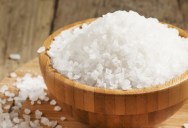
For those who have this issue on their window, a solution that is commonly proposed is placing a bowl full of salt near the window. The idea is that the salt will absorb the moisture from the air before it reaches a point where it can condensate on the window.
In theory, this is possible. Salt can indeed pull moisture out of the air in certain situations. The problem, however, is that the scenario where condensation most commonly occurs is not one of them. The German Transport Information Service says the following about how and when salt pulls humidity from the air:
“At up to 74 percent relative humidity and 20°C [68°F], salt does not absorb any appreciable quantities of water vapor. The critical water content of sodium chloride (NaCl) is 0.5 percent at 74 percent relative humidity, which is the flow moisture point at which salt begins readily to absorb water vapor, and increases such that, at 75 percent relative humidity, the salt dissolves.”
Since houses in the winter are usually far dryer than 75% relative humidity, the salt isn’t going to do anything to prevent condensation, or at least not much at all.
Shutterstock
So, how can you fix the problem? The simplest way is to improve ventilation in the area. Good ventilation can help to prevent water vapor from building up on the windows themselves. This can be done by leaving the window slightly open (if it isn’t too cold outside), running a fan on or near the window, or making sure that any HVAC vents near the window are clear and working properly.
If you want to give it a try, however, a bowl of salt is an easy and inexpensive option and in some specific situations, it can even be effective.
If you thought that was interesting, you might like to read a story that reveals Earth’s priciest precious metal isn’t gold or platinum and costs over $10,000 an ounce!





Sign up to get our BEST stories of the week straight to your inbox.
